EVA foam runs 33–280 kg/m³. EPDM rubber runs 1,070–1,200 kg/m³. Both end up on gym floors, and even the densest foam is still nearly four times lighter than the lightest rubber — yet neither foam density figure tells you how firm the floor feels underfoot.
That is the trap in most spec sheets.
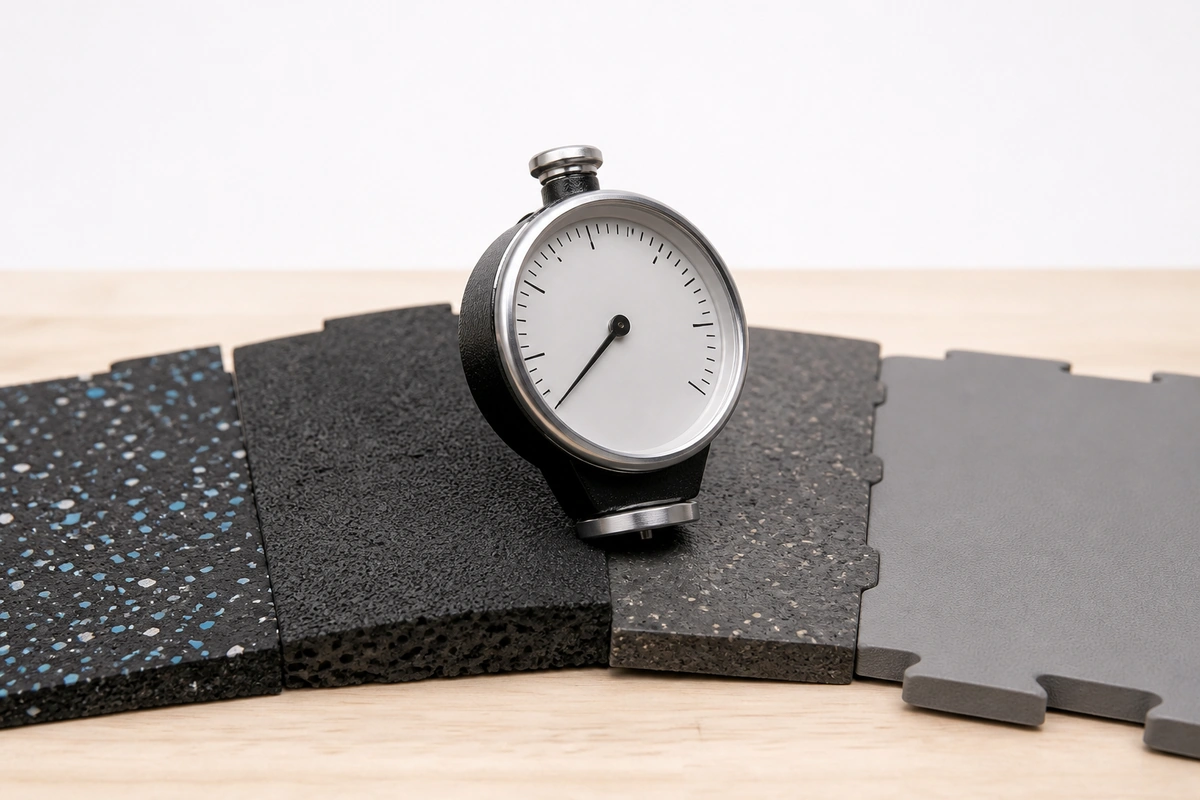
Foam density is how much material is packed into a given volume (kg/m³ or lb/ft³). Shore hardness is how far a spring-loaded pin sinks into the surface, measured under ASTM D2240. They are separate properties. No formula turns one into the other: a dense foam can be soft, and a light foam can be firm.
So foam density vs Shore-A is a lookup, not a conversion. The table below gives the published density and hardness ranges for EVA, cross-linked polyethylene, polyurethane, SBR, EPDM, and PVC — plus the hardness scale each material is actually sold on.
The Reference Table: Density, Shore Hardness, and Use Case
One row per material class. Read across: density band, the hardness scale that material is genuinely specified on, and where it shows up in flooring.
| Material class | Typical density | Hardness (scale + range) | Measured under | Typical flooring role |
|---|---|---|---|---|
| EVA foam — low density | 33–60 kg/m³ (2.0–3.7 lb/ft³) | 15–25 Shore 00 | ASTM D2240 | Yoga and stretch mats, soft play surfaces |
| EVA foam — medium density | 60–150 kg/m³ (3.7–9.3 lb/ft³) | 25–55 Shore C | ASTM D2240 | Puzzle play mats, light home-gym tiles |
| EVA foam — high density | 150–280 kg/m³ (9.3–17.5 lb/ft³) | 30–60 Shore A | ASTM D2240 | Heavy-duty pads, tool trays, standing mats |
| XLPE / cross-linked PE foam | 28–240 kg/m³ | Not published by suppliers | Cellular foams fall on Shore 00 / C | Underlayment, impact and vibration padding |
| Flexible polyurethane foam | 16–80 kg/m³ (1.0–5.0 lb/ft³) | Specified by IFD, not Shore | IFD at 25% deflection | Anti-fatigue mat cores, cushion layers |
| Rigid / structural polyurethane | 96–200+ kg/m³ (6–12+ lb/ft³) | Not a Shore-A material | — | Load-bearing cores, tooling board |
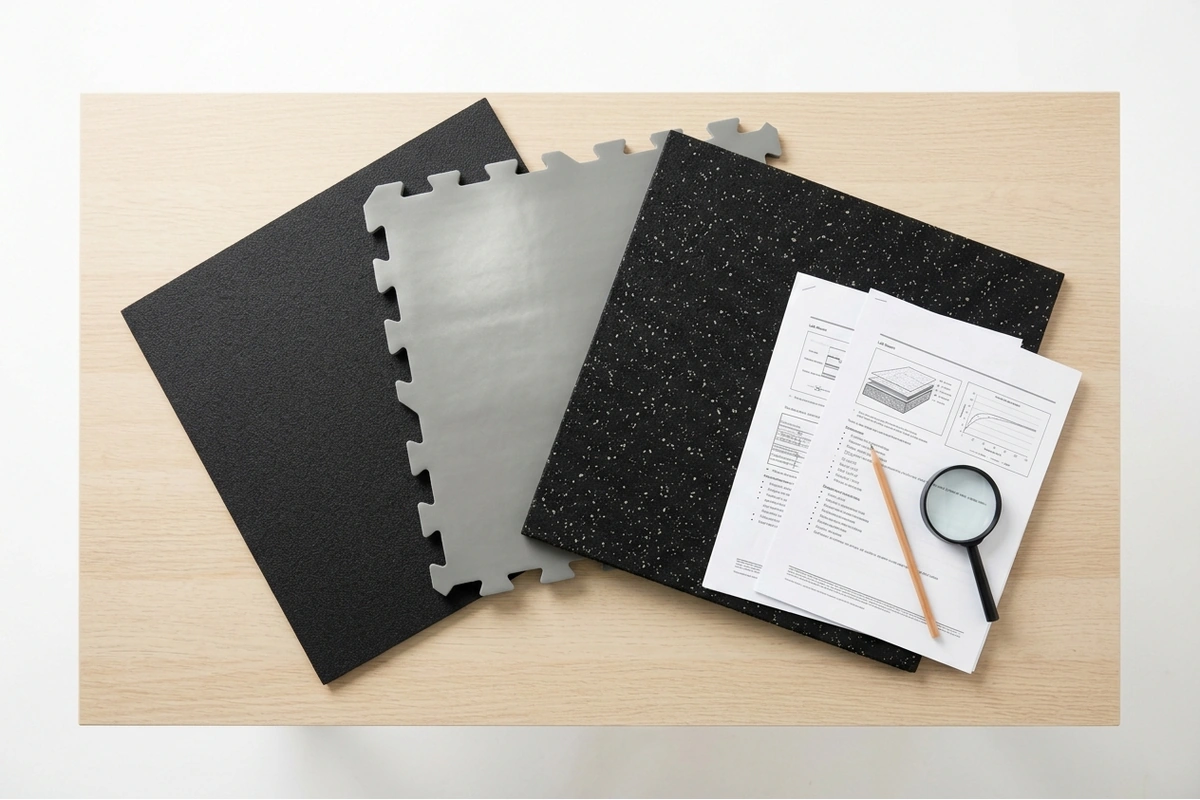
| SBR (styrene-butadiene rubber) | 1,000–1,300 kg/m³ | 50–80 Shore A | ASTM D2240 | Gym tiles and rolls, crumb-bonded mats |
| EPDM rubber | 1,070–1,200 kg/m³ | 30–90 Shore A, grade-dependent | ASTM D2240 | Premium gym, outdoor, playground surfacing |
| Flexible (plasticized) PVC | 1.19–1.35 g/cm³ = 1,190–1,350 kg/m³ | High Shore A — supplier-specific | ASTM D792 density; ISO 868 hardness | Interlocking garage and workshop tiles |
| Rigid (unplasticized) PVC | 1.35–1.45 g/cm³ | Reads on Shore D, not Shore A | ASTM D792 | Rigid tile substrate, trim, edging |
Test methods: ASTM D2240 and ISO 868 (hardness), ASTM D792 (PVC density). The ranges come from raw-material data sheets, trade-association foam data, and the test standards themselves — full citation list at the end.
Fact: Foam and solid flooring materials differ in density by nearly four times at minimum, and by more than forty times at the extremes: EVA foam runs 33–280 kg/m³, while solid rubber and PVC run 1,000–1,450 kg/m³ (raw-material data sheets and materials-lab density data).
Why Density Doesn’t Predict Firmness
Treating density as a stand-in for firmness is the most common mistake with these numbers.
Density counts how much polymer sits in a given volume. Hardness counts how far a standard pin sinks in. A manufacturer can change either one without changing the other — the chemical formulation and the amount the foam is expanded are separate dials.
That’s how a good anti-fatigue mat works. Dense enough not to flatten out over five years, soft enough to still feel like cushioning at hour seven.
Use the table as a lookup. A spec sheet that gives density only has told you about durability and load resistance, not about feel.
Which Shore Scale Applies to Which Material
ASTM D2240 is titled “Standard Test Method for Rubber Property—Durometer Hardness,” and it covers twelve durometer types: A, B, C, D, DO, E, M, O, OO, OOO, OOO-S, and R. It applies to vulcanized rubber, thermoplastic elastomers, cellular materials, gels, and some plastics.
Pick the wrong scale and you get a number that looks official and means nothing.
| Scale | What it’s meant to measure |
|---|---|
| Shore 00 | Expanded, sponge, and cellular rubber |
| Shore A | Soft rubber, elastomers, natural rubber |
| Shore B | Elastomers harder than Shore A |
| Shore C | Medium-hard elastomers |
| Shore D | Harder elastomers, plastics, rigid thermoplastics |
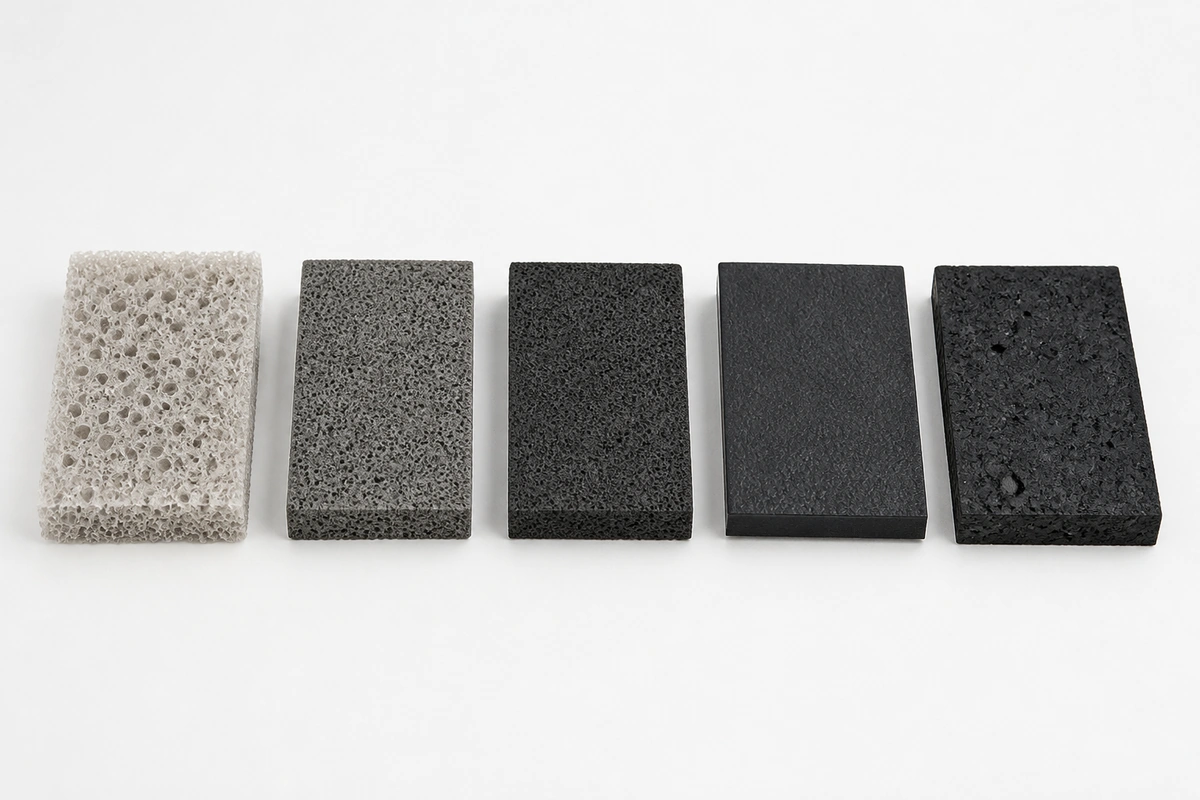
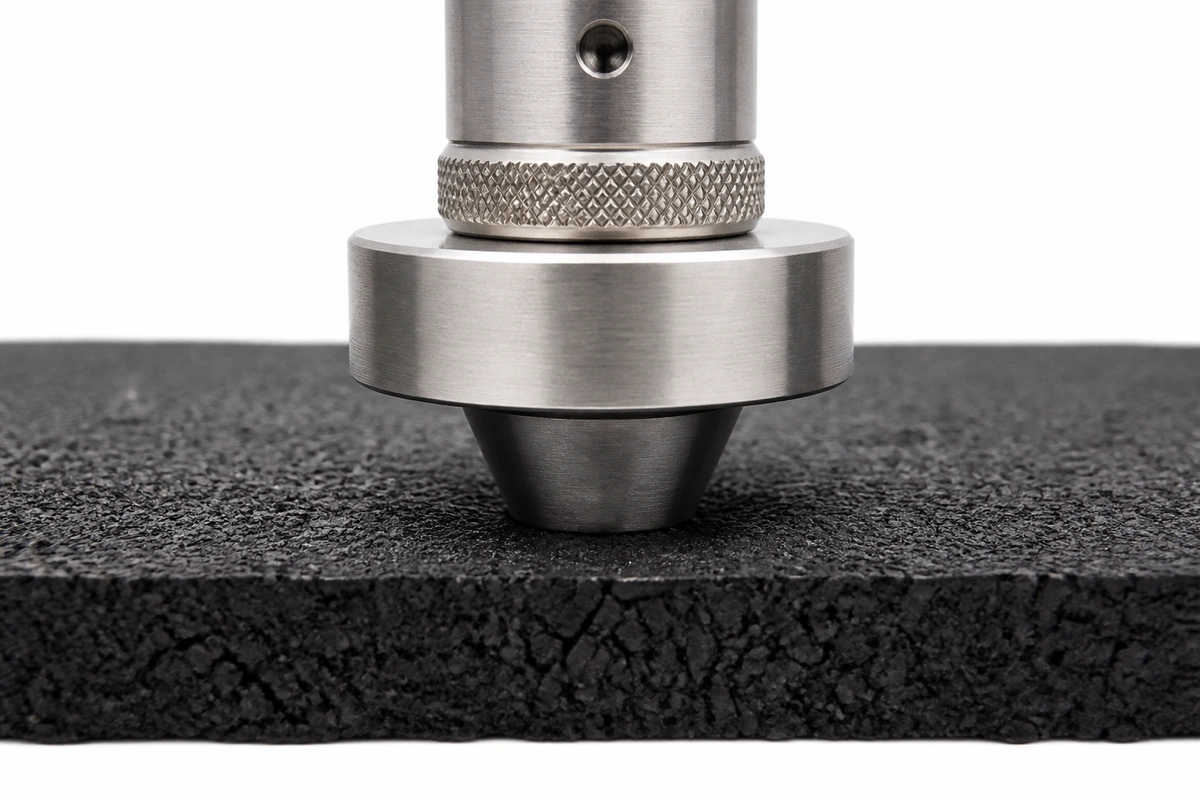
The scale is an upside-down depth reading. 0 Shore means the pin sank the full 2.5 mm; 100 Shore means it didn’t sink at all. Softer material, deeper indent, lower number.
One catch: the scales overlap at the top. A material that reads 95A also reads 45D, so two suppliers can quote the same compound on different scales and look like they disagree.
For a feel anchor, Shore 70A is about as hard as a car tire.
Foam gets its own rule. Use Shore C for EVA, not Shore A. The Shore A test punctures the foam’s cell walls and returns unstable readings — it is measuring cell collapse, not hardness. Shore C gives repeatable numbers batch to batch.
Fact: On the Shore scale, 0 means the indenter penetrated 2.5 mm and 100 means it did not penetrate at all (ASTM D2240).
Foam Density Bands in Detail
EVA foam
EVA is what most interlocking puzzle mats are made of. Its density-to-hardness chart is the closest thing this category has to a standard lookup.
| Density (kg/m³) | Density (lb/ft³) | Hardness | Stated applications |
|---|---|---|---|
| 33–60 | 2.0–3.7 | 15–25 Shore 00 | Yoga blocks, soft packaging, retail inserts |
| 60–100 | 3.7–6.2 | 25–40 Shore C | General packaging inserts, protective padding |
| 100–150 | 6.2–9.3 | 40–55 Shore C | Orthotics, case liners, marine backing |
| 150–220 | 9.3–13.7 | 30–45 Shore A | Tool trays, industrial gaskets, heavy pads |
| 220–280 | 13.7–17.5 | 45–60 Shore A | Machine gaskets, structural spacers, wheels |
Manufacturer-published EVA density and hardness chart. Note the scale switch between the third and fourth rows — that’s where the foam stops behaving like a sponge and gets firm enough for a Shore A reading to mean something.
To convert between the two density columns: 1 kg/m³ = 0.0624 lb/ft³.
Cross-linked polyethylene (XLPE)
XLPE runs roughly 28–240 kg/m³ across commercially available grades.
The practical difference from EVA is the cell structure. XLPE’s fine, uniform closed cells barely absorb water, which is why it turns up as underlayment and impact padding rather than as a wear surface.
The XLPE data sheets carry no Shore hardness figure at all. That’s not an oversight to paper over with a guess — foams like this are bought on density and compression behavior, and the honest cell in the table is the empty one.
Flexible polyurethane
Flexible PU is the core of most premium anti-fatigue mats, and it’s the clearest case of a material that isn’t sold in Shore-A at all.
Density runs 16–30 kg/m³ for light cushioning and packaging, 30–50 kg/m³ for standard furniture and mattress grades, and 40–80 kg/m³ for high-resilience grades. Rigid structural versions start around 96 kg/m³ and go past 200.
Firmness comes from a different test. The Polyurethane Foam Association uses IFD — how much force, in pounds, it takes to press a foam sample down by 25% of its height. A second number, support factor, runs from about 1.5 to 2.6; higher means the foam holds up better under weight.
So don’t ask a PU mat supplier for a Shore-A number. Ask for density plus IFD.
Fact: Flexible polyurethane foam is specified by density plus IFD — the force in pounds needed to press a sample down 25% of its height — with support factors of about 1.5 to 2.6, not by Shore-A hardness (Polyurethane Foam Association).
Rubber and PVC Hardness in Detail
Solid rubber is where Shore A earns its keep. The numbers below are the vulcanized-compound ranges published on raw-material data sheets.
| Property | SBR (styrene-butadiene) | EPDM |
|---|---|---|
| Density | 1.0–1.3 g/cm³ (1,000–1,300 kg/m³) | 1.07–1.20 g/cm³ (1,070–1,200 kg/m³) |
| Shore A | 50–80 | 30–90 |
| Tensile strength | 7–15 MPa | 10–21 MPa (1,500–3,000 psi) |
| Service temperature | −40 °C to +100 °C | −50 °C to +150 °C |
| Weather and sunlight | Poor | High ozone and weather resistance |
These are compound ranges, not finished-floor specs. A bonded crumb-rubber tile is made from this rubber but is a porous composite, so its own density and durometer depend on the binder and the press — ask the tile supplier for the tile’s numbers, not the polymer’s.
Weathering, not tensile strength, is the row that decides an outdoor install. EPDM’s saturated backbone gives it high ozone and weather resistance; SBR ages badly in sunlight. That, plus a service ceiling 50 degrees higher, is why EPDM goes on playgrounds and outdoor decks while SBR stays indoors on price.
PVC sits at the hard end of the flexible range — high enough that the durometer scale itself starts to run out. ISO 868 tells you to switch to the type D durometer once a type A reading goes above 90, which is exactly where a finished interlocking tile lands. Suppliers who quote a Shore A number for a garage tile are quoting the top of the band.
Raw PVC density depends on how much plasticizer — the additive that makes it flexible — is in the mix. Flexible grades run 1.19–1.35 g/cm³, rigid grades 1.35–1.45 g/cm³. Both are measured under ASTM D792.
Fact: ISO 868 recommends switching to the type D durometer once a type A reading exceeds 90 — which is why finished PVC floor tile, sitting at the top of the Shore A band, is often quoted on both scales.
Flooring Spec Lookup by Use Case
Working backwards from the application is usually faster than working forwards from a material.
| Application | Material to specify | Density to ask for | Hardness to ask for |
|---|---|---|---|
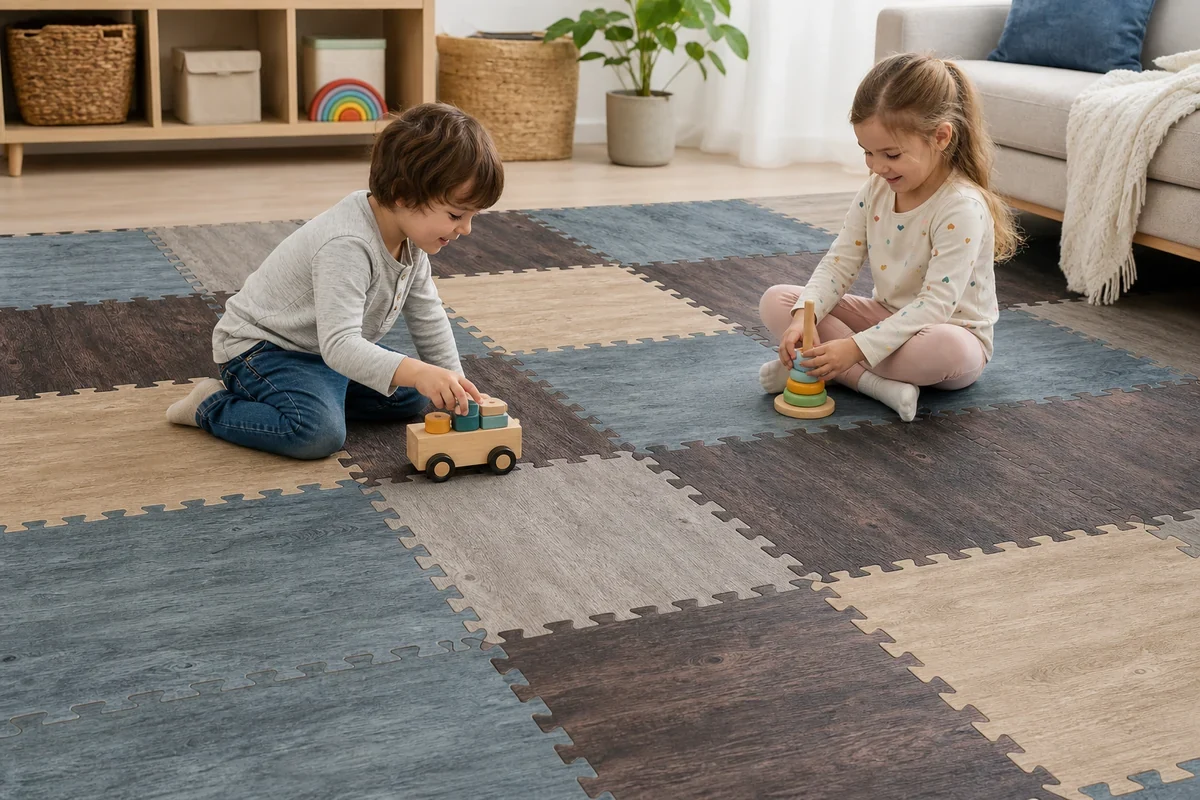
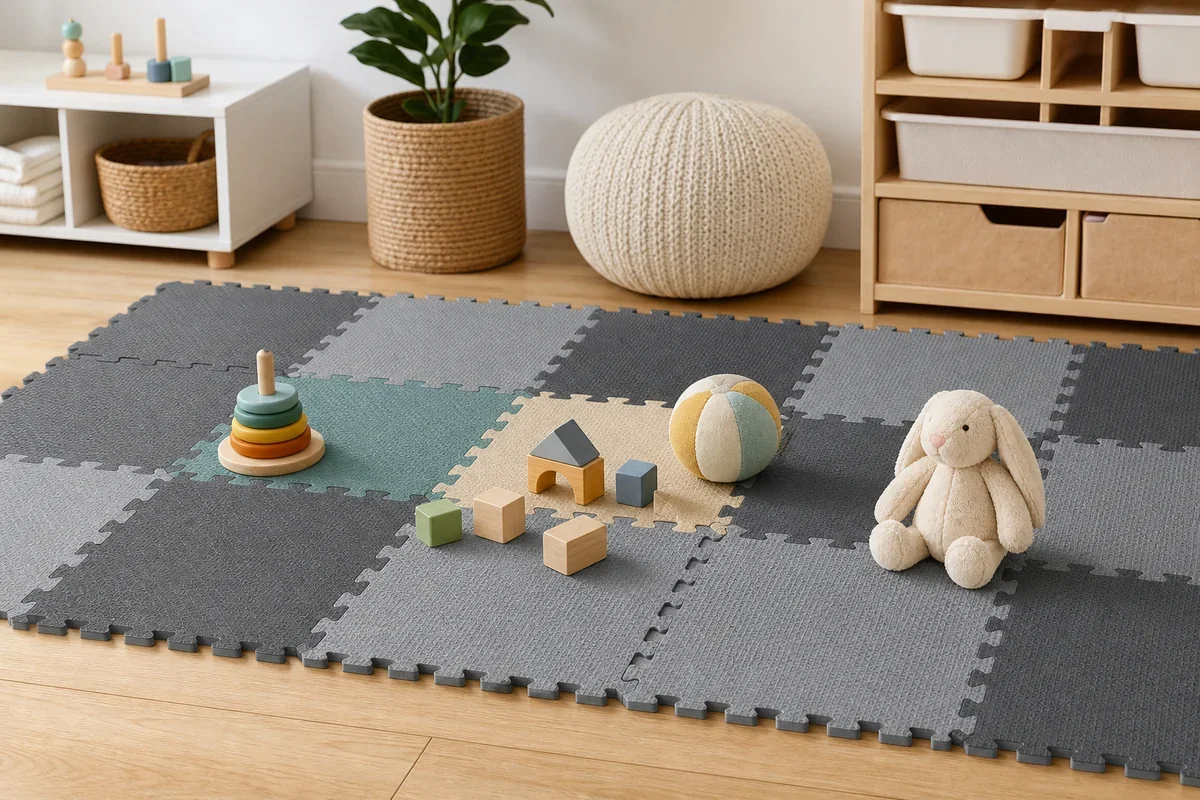
| Toddler / play mat | EVA foam | 60–150 kg/m³ | 25–55 Shore C |
| Yoga and stretching | EVA or XLPE foam | 33–60 kg/m³ | 15–25 Shore 00 (EVA only — XLPE has no published Shore rating) |
| Light home-gym tile | High-density EVA | 150–280 kg/m³ | 30–60 Shore A |
| Standing / anti-fatigue mat | Flexible PU or high-density EVA | 40–80 kg/m³ (PU) | IFD, not Shore |
| Weight-room tile, indoor | SBR crumb rubber | 1,000–1,300 kg/m³ | 50–80 Shore A |
| Outdoor or playground surface | EPDM | 1,070–1,200 kg/m³ | 30–90 Shore A, grade-dependent |
| Garage or workshop tile | Flexible PVC | 1.19–1.35 g/cm³ | Top of the Shore A band (above 90 A, read on Shore D) |
Two things this table can’t tell you.
Thickness is separate. A 12 mm tile and a 4 mm tile of identical density and hardness behave completely differently under a dropped barbell — see the thickness thresholds in the weightlifting flooring guide.
Noise is separate too. Impact sound is rated by IIC under ASTM E989 and has to be tested as a whole floor assembly, which is why the apartment gym flooring guide quotes IIC numbers instead of durometer values.
What Norsk-Stor Publishes, and What It Doesn’t
Norsk-Stor publishes this guide and sells the products below, so here’s the straight answer: Norsk-Stor does not publish a durometer or density figure for any product in its catalogue. No Shore-A, no kg/m³. Anyone who needs those values for a submittal should request them from the manufacturer directly.
What the catalogue does publish is dimensions and load data:
- Interlocking PVC tiles (DURAFLEX Raised Diamond, Raised Coin, RHINO-TEC Sport, Vented Drain): 0.25″ thick, with a 0.28″ hidden-interlock version. Rated 5,000 lbs rolling load and 20,000 lbs static load.
- DURAFLEX reversible foam mats: 0.79″ (20 mm), with a 0.51″ (13 mm) standard version.
- Rubber-Tec gym tiles: 0.47″ (12 mm) and 0.70″ (18 mm). A rubber and co-polymer blend top layer over a hi-density rubber co-polymer core — not recycled crumb, which is why they arrive without the crumb-rubber odor.
- Acoustics: the 0.47″ tile is quoted at roughly a 20 point IIC improvement — Norsk-Stor’s own figure, with no third-party assembly test published behind it.
Load ratings answer “will this survive a floor jack.” Thickness answers “will this survive a dropped plate.” IIC answers “will my neighbor hear it.” None of them answers “how firm does it feel,” and no honest table pretends otherwise.
Frequently Asked Questions
Can I convert foam density into a Shore-A number?
No. Density and hardness are set independently by the formulation and the expansion ratio, so no conversion factor exists. A 220 kg/m³ EVA can be softer than a 150 kg/m³ EVA. Use a published lookup for the specific material and ask the supplier for both figures.
What Shore scale should be used for foam?
Shore C for EVA and similar medium-hard foams; Shore 00 for expanded, sponge, and cellular rubber. Shore A punctures foam cell walls and returns unstable readings. ASTM D2240 defines all twelve scales — match the scale to the material.
What foam density do I need for a home gym tile?
For bodyweight training and light dumbbells, specify high-density EVA at 150–280 kg/m³, which lands at 30–60 Shore A. Below roughly 150 kg/m³, EVA is specified for padding and inserts, not floor loads. For barbell work, move to rubber at 1,000+ kg/m³ rather than adding foam thickness.
Is a higher Shore-A number always better for flooring?
No. Higher Shore-A means more indentation resistance and less cushioning — right for a workshop PVC tile at the top of the Shore A band, wrong for a standing mat. Match hardness to the failure you’re trying to prevent: dropped tools want hardness, eight-hour shifts want give.
How is rubber hardness actually measured?
Under ASTM D2240, with a spring-loaded indenter pressed into the surface for a set time. The reading is inverted depth: 0 means the pin sank the full 2.5 mm, 100 means it didn’t sink at all. Shore A is the scale used for gym rubber and PVC tile.
Why do anti-fatigue mat suppliers quote IFD instead of Shore-A?
Because flexible polyurethane isn’t a Shore-A material. The Polyurethane Foam Association specifies it by density plus IFD — the pounds of force needed to compress a sample 25% — plus a support factor of roughly 1.5 to 2.6. Ask a PU supplier for a durometer figure and there is no standard behind whatever number comes back.
The Bottom Line
- Density and hardness are independent. No formula converts between them.
- Match the scale to the material: Shore 00 and C for foams, Shore A for solid rubber and PVC tile, Shore D above 95A.
- Flexible polyurethane is specified by density and IFD, never by Shore-A.
- Foams run 16–280 kg/m³; rubber runs 1,000–1,300 kg/m³ and PVC 1,190–1,450 kg/m³. That gap, not the hardness number, is what separates a cushion from a wear surface.
- Thickness and IIC are separate variables no durometer figure predicts.
For how these materials compare as finished floors, start with the garage flooring options guide. For standing comfort specifically, the anti-fatigue mat guide covers material selection by shift length.
Specifying a floor and want dimensional and load data on a specific product?
Questions about a spec? Call 888-443-9058 or email customerservice@norsk-stor.com.
Sources
- ASTM International. D2240-15(2021) Standard Test Method for Rubber Property—Durometer Hardness. store.astm.org
- Durometer hardness test-method and scale reference, instrument manufacturer. zwickroell.com
- Durometer Shore hardness scale comparison chart, materials supplier. smooth-on.com
- Manufacturer-published EVA foam density and hardness chart with PCF conversions. damao-tech.com
- Manufacturer guide to EVA foam density and Shore A / Shore C hardness. damao-tech.com
- EPDM material properties — compound density, durometer, tensile and service range. xometry.com
- EPDM material data sheet, sealing-materials manufacturer — specific weight and weather resistance. emico.com
- SBR material specification, gasket-materials manufacturer — density, hardness, tensile and temperature range. breinerco.com
- SBR material data sheet — durometer range, tensile range and weather/sunlight ageing. legacyrubber.com
- Manufacturer-published PU foam density chart by grade. blendpolyol.com
- Polyurethane Foam Association. Foam Performance. pfa.org
- Supplier specification for XLPE cross-linked PE foam grades. kristofoam.com
- ISO. ISO 868:2003 Plastics and ebonite — Determination of indentation hardness by means of a durometer (Shore hardness). iso.org
- Materials-lab reference on PVC density and ASTM D792 measurement. infinitalab.com