Your workshop floor takes more abuse than any other surface in your home.
Dropped wrenches. Spilled chemicals. Eight hours standing on cold concrete while you finish a build. If your knees ache by lunchtime, you already know the problem.
Whether you’re a weekend woodworker, a dedicated home mechanic, or running a small fabrication business out of your garage, the right workshop flooring eliminates fatigue, damage, and messy cleanup — without requiring a professional installer.
I’ll compare the four best workshop flooring types, show you how to plan zones for different work areas, and break down real costs by workshop size.
Here’s what you need to know.
Quick Answer: For most workshops, diamond-pattern interlocking PVC tiles are the best all-round floor — they resist oil, dropped tools, and rolling toolboxes, install in an afternoon, and stay comfortable underfoot. Use rubber in heavy-impact or anti-fatigue zones, and epoxy only where you need a seamless chemical-resistant surface over a sound slab. Plan zones so each work area gets the right surface.
Quick Picks: Best Workshop Flooring at a Glance
| Need | Best Pick | Price | Why |
|---|---|---|---|
| Best Overall | DURAFLEX Diamond PVC Tiles | ~$2.15/sq ft | Chemical resistant, 20K lb load, DIY install |
| Best for Standing Zones | DURAFLEX Reversible Foam 0.79″ | ~$1.42/sq ft | 20mm EVA cushion for workbench fatigue |
| Best for Wet Areas | Raised Coin PVC Tiles | ~$2.08/sq ft | Micro-traction grip, channels water |
| Best Combo | Diamond tiles + Foam mats | ~$2.00/sq ft avg | Full coverage + targeted comfort |
Now let’s break down why each option works — and where each one falls short.
Why Your Workshop Floor Matters More Than You Think
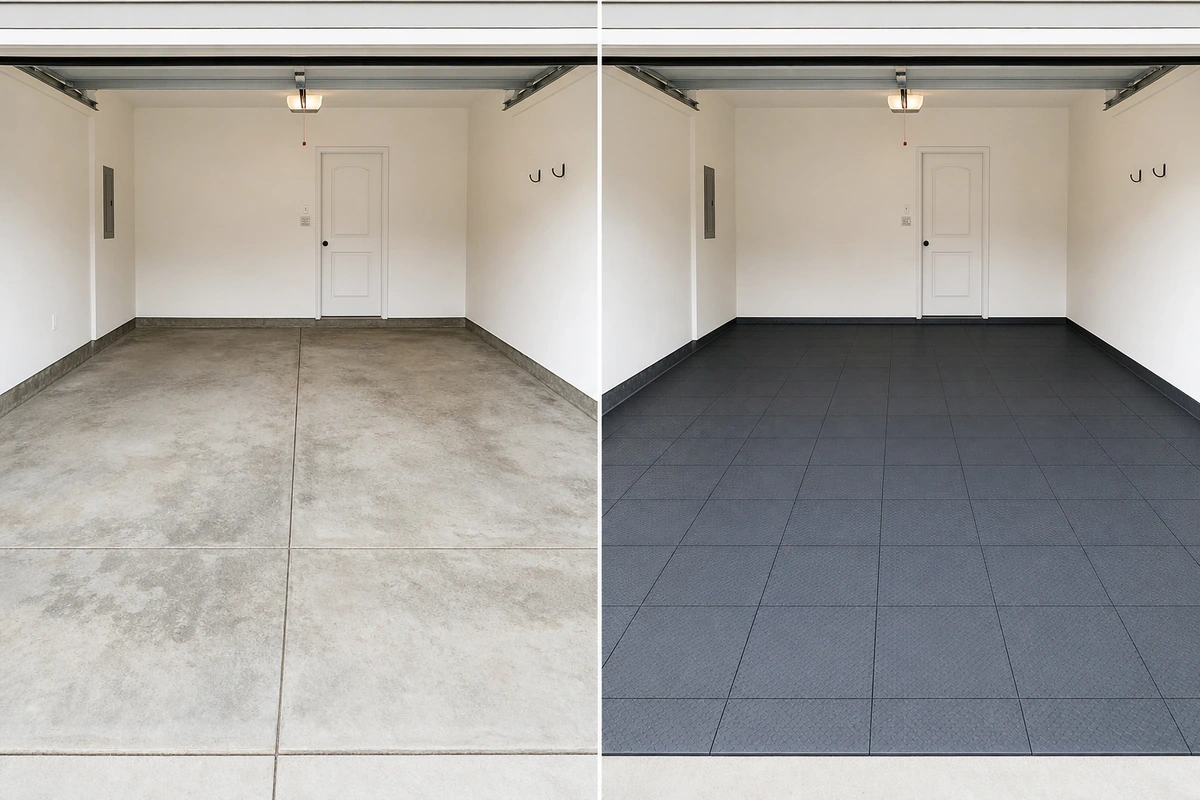
Bare concrete is the default workshop floor. It’s also the worst.
Concrete transmits cold directly into your feet. It cracks under point impacts. It absorbs oil stains permanently. And standing on it for extended sessions creates real joint problems over time.
Here’s the deal: workshop flooring isn’t just about looks. It’s about working longer, safer, and with less cleanup.
The right floor gives you:
- Impact protection — dropped tools bounce instead of chip
- Chemical resistance — oil, coolant, and solvents wipe clean
- Anti-fatigue comfort — less strain during long standing sessions
- Thermal insulation — warmer feet in unheated spaces
- Easy maintenance — sweep, mop, done
The question is: which flooring type handles workshop conditions best?
The 4 Workshop Flooring Options Worth Considering
Not every flooring type works in a workshop. Here’s what does — and what each one does best.
PVC Interlocking Tiles — Best All-Around
PVC tiles are the go-to for serious workshops. They handle chemicals, heavy loads, and rolling equipment without breaking a sweat.
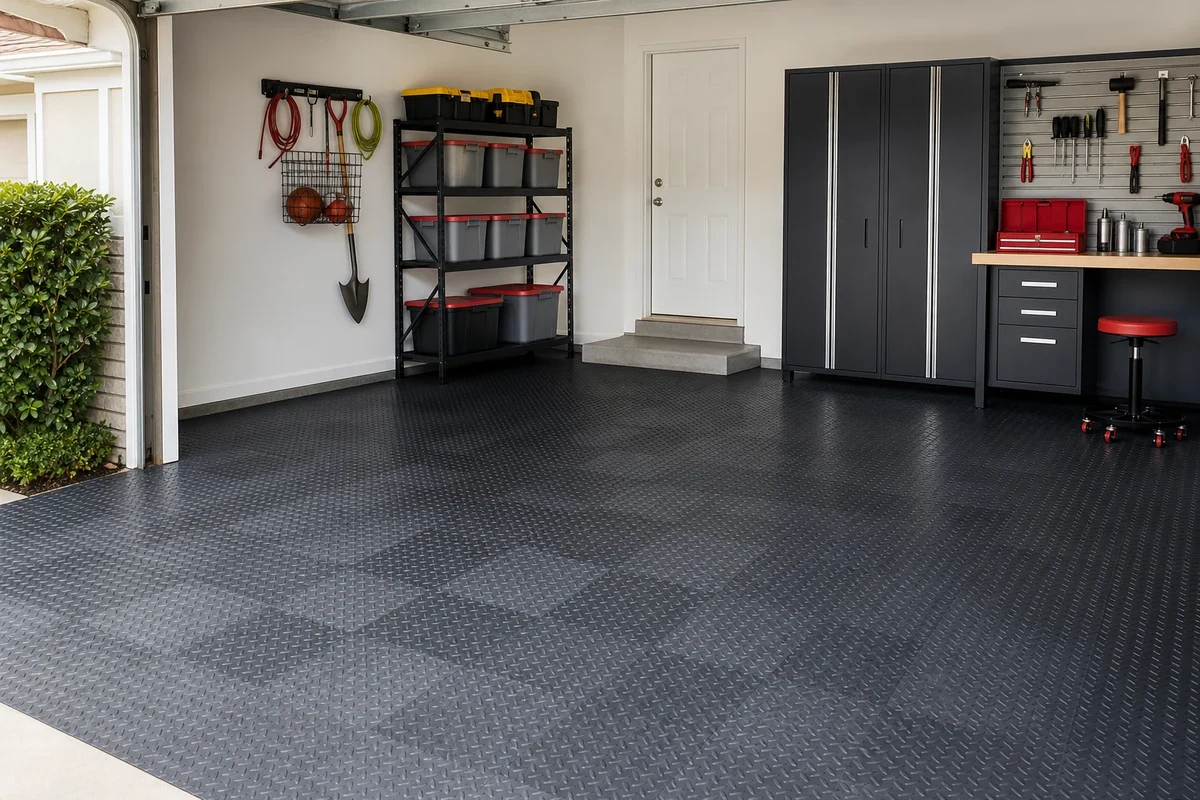
The DURAFLEX Diamond PVC Tiles are built for exactly this environment. The raised diamond pattern hides scratches and scuffs — inevitable in any working shop.
Key specs that matter for workshops:
- Rolling load: 5,000 lbs (tool carts, floor jacks, rolling toolboxes)
- Static load: 20,000 lbs (table saws, compressors, drill presses)
- Chemical resistance: Oil, coolant, brake fluid, winter salt — wipes clean
- Install: DIY floating system — no glue, no special tools beyond a rubber mallet
- Cost: ~$2.15 per square foot (6-pack covers 24 sq ft)
- Colors: Black, metallic graphite, metallic tin
- Warranty: Limited lifetime
Why diamond pattern specifically for workshops? It hides scuffs and scratches that accumulate fast in any working environment. The textured surface also provides grip without catching rolling casters.
The catch? PVC tiles provide moderate cushioning, not full anti-fatigue comfort. For dedicated standing zones, you’ll want to layer foam mats on top.
Rubber Tiles — Best for Comfort
Rubber excels at shock absorption and standing comfort. It’s the material gym floors are made from, and those same properties translate to workshop use.
But here’s the catch: rubber attracts visible dust. Sawdust that disappears on concrete shows up immediately on dark rubber surfaces. You’ll vacuum more often than you’d like.
Rubber also has lower chemical resistance than PVC. Certain solvents, oils, and cleaning chemicals degrade rubber over time — a real concern for automotive or finishing workshops.
And rolling carts? They sink into rubber slightly, creating more resistance. Not ideal for a shop where you’re constantly moving tool chests around.
Bottom line: rubber works well as a standing-zone solution at specific workstations, not as a full-floor workshop covering.
Foam Mats — Best for Workbench Zones
EVA foam mats deliver maximum anti-fatigue comfort at the lowest cost. The DURAFLEX Reversible Foam Mats (0.79″) provide 20mm of cushioning — enough to make a noticeable difference during all-day bench sessions.
At ~$1.42 per square foot, foam mats are the budget anti-fatigue play.
The catch? Foam is too soft for full-floor coverage. Rolling carts sink in. Heavy equipment compresses it permanently. Use foam strategically at workbench stations, not wall-to-wall.
Epoxy Coating — When to Choose It Instead
Epoxy creates a seamless, chemical-resistant surface bonded directly to your concrete. It’s the gold standard for professional automotive shops.
But for most home workshops, epoxy has serious downsides:
- Professional installation required ($3–$12 per square foot)
- 2–3 day cure time (shop is unusable)
- Not reversible — you can’t take it with you
- No anti-fatigue properties whatsoever
If you’re comparing epoxy directly against tiles, our epoxy vs. interlocking tiles guide covers every tradeoff in detail.
For DIY workshop owners, PVC tiles win on flexibility, cost, and install speed.
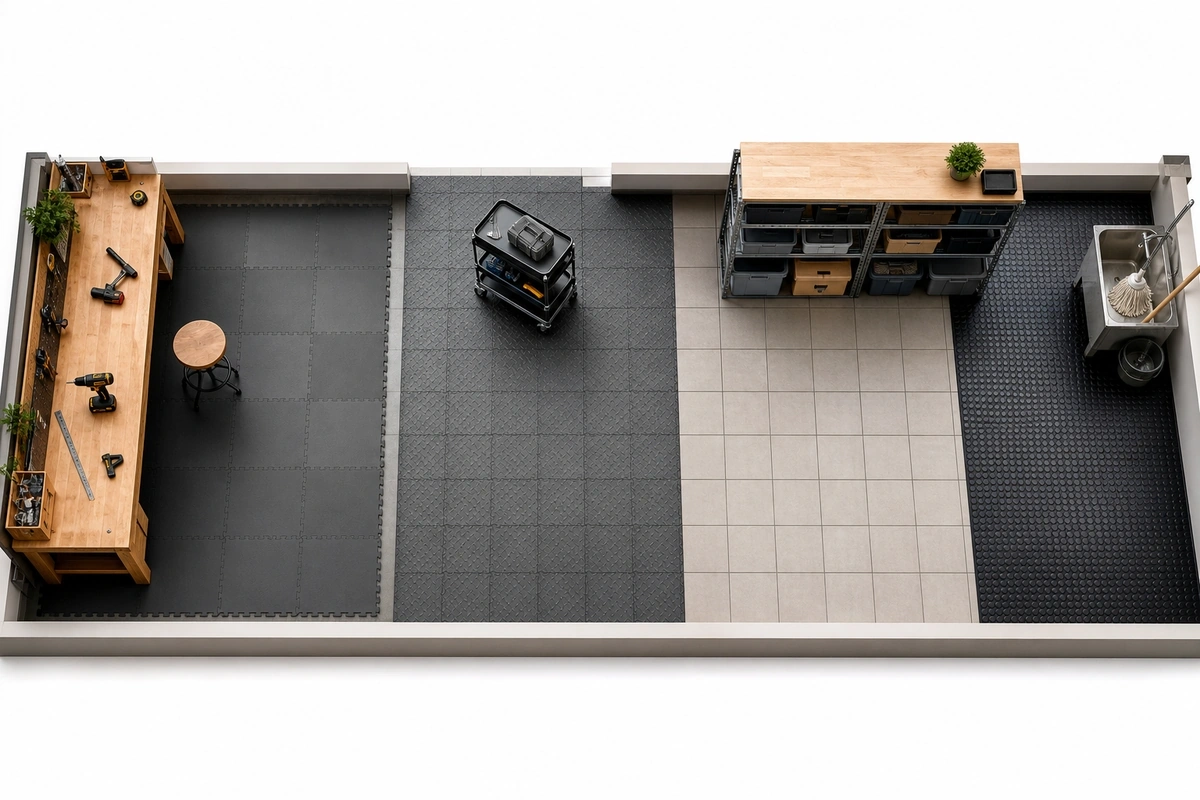
Workshop Zone Planning: Match Your Floor to Your Work
Here’s where most workshop flooring guides fall short. They treat the entire floor as one surface.
Your workshop has different zones with different demands. Planning for them separately gets you better results at lower cost.
Zone 1 — The Workbench Area
This is where you stand the longest. Anti-fatigue matters most here.
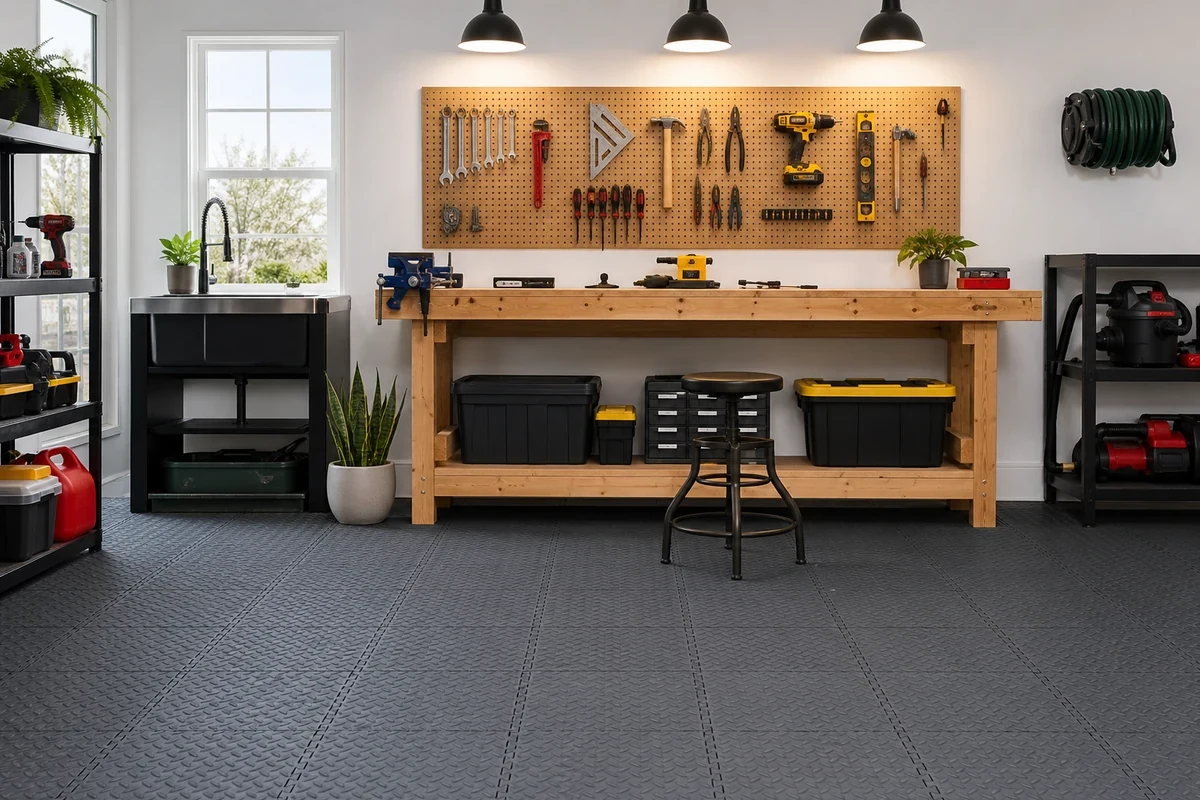
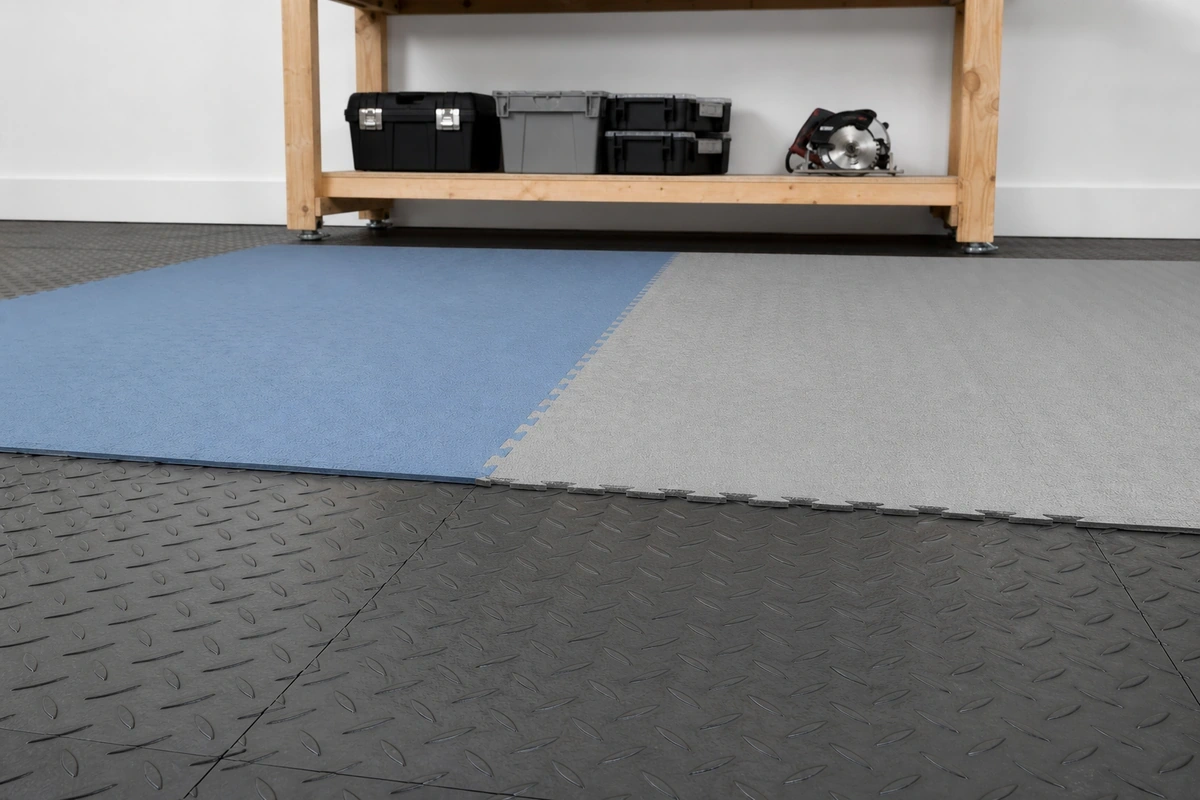
Best approach: Lay PVC Diamond tiles as the base floor, then add DURAFLEX Foam Mats (0.79″) directly at your primary bench stations. This dual-layer approach gives you chemical-resistant flooring everywhere with targeted anti-fatigue comfort where you stand the longest.
A full-floor foam setup sounds tempting but creates problems. Foam compresses under heavy equipment, makes rolling carts harder to push, and provides less chemical protection than PVC.
Why solid tiles matter here: small parts — screws, washers, drill bits — won’t disappear through drainage holes. The smooth diamond surface makes dropped hardware easy to spot and pick up. If you’ve ever lost a crucial fastener into a vented tile, you understand the frustration.
Zone 2 — Rolling Equipment Paths
Tool carts, rolling toolboxes, and floor jacks need a hard, smooth surface.
PVC Diamond tiles handle this perfectly. The 5,000 lb rolling load rating means your fully loaded tool chest rolls freely without resistance or surface damage. The hard surface maintains dimensional stability under repeated rolling traffic — no ruts, no compression marks, no wear paths.
This is where PVC separates itself from every other option. Foam and rubber are poor choices for rolling paths — carts dig in and require noticeably more effort to push. Even high-density rubber creates enough resistance to make moving a loaded cart annoying over time.
Zone 3 — Storage and Heavy Equipment
Table saws, drill presses, compressors, and shelving create concentrated point loads.
The 20,000 lb static load rating on DURAFLEX Diamond tiles handles all of it. No crushing, no permanent compression marks.
Pro tip: lay tiles under equipment before placing it. Trying to retrofit tiles around a 300-lb table saw is not fun.
Zone 4 — Wet Process Areas (If Applicable)
Some workshops involve regular water use — parts washing, wet sanding, or cleanup hose-down.
For these zones, Raised Coin PVC Tiles provide superior wet grip through their consistent micro-traction texture. The coin pattern channels water away from the walking surface.
Most workshops won’t need a dedicated wet zone. If yours doesn’t involve regular water, use Diamond tiles everywhere and skip this zone entirely.
Here’s why this matters: zone planning lets you spend more where it counts (anti-fatigue at the bench) and less where you don’t need premium features (storage areas). A smart mix of PVC tiles and foam mats costs less than full-floor rubber or professional epoxy — and outperforms both for workshop use.
For more on standing comfort specifically, our anti-fatigue mat guide covers the science of fatigue reduction in depth, and the kitchen anti-fatigue mat guide applies the same selection logic if your longest standing hours happen at a counter instead of a workbench.
PVC vs. Rubber vs. Epoxy: Workshop-Specific Comparison
| Factor | PVC Tiles | Rubber Tiles | Epoxy Coating |
|---|---|---|---|
| DIY Install | Yes (4-6 hrs) | Yes (4-6 hrs) | No (pro required) |
| Chemical Resistance | Excellent | Good | Excellent |
| Anti-Fatigue | Moderate | Good | None |
| Rolling Cart Friendly | Excellent | Poor | Excellent |
| Sawdust Visibility | Low (pattern hides) | High (shows everything) | Low |
| Reversible/Removable | Yes | Yes | No |
| Thermal Insulation | Good | Good | None |
| Cost per sq ft | ~$2.15 | ~$3.50+ | $3–$12 |
| Install Time (400 sq ft) | 4-6 hours | 4-6 hours | 2-3 days |
| Warranty | Lifetime (limited) | Varies | Varies |
The clear winner for most workshops: PVC interlocking tiles. They match epoxy on chemical resistance and durability while beating it on install speed, cost, and flexibility.
For a deeper look at how our garage flooring options compare across all use cases, check our full comparison guide.
Real Cost Breakdown by Workshop Size
Here’s what workshop flooring actually costs with DURAFLEX Diamond PVC Tiles:
| Workshop Size | Dimensions | Tiles Needed | Cost (tiles only) | With 5% Waste |
|---|---|---|---|---|
| Small | 10′ × 10′ (100 sq ft) | ~17 packs | ~$875 | ~$919 |
| Medium | 14′ × 14′ (200 sq ft) | ~34 packs | ~$1,751 | ~$1,838 |
| Large | 20′ × 20′ (400 sq ft) | ~67 packs | ~$3,450 | ~$3,622 |
Zone Mix Example (Most Cost-Effective)
- 300 sq ft PVC Diamond tiles: ~$2,588
- 50 sq ft foam mats at workbenches: ~$285
- Total: ~$2,873 for a large workshop with anti-fatigue zones
Add ~$50-80 for beveled edge trim pieces to create clean transitions at doorways and open edges.
How to calculate your needs:
- Measure length × width (in feet)
- Add 5% for cuts and waste
- Divide by 24 (each 6-pack covers 24 sq ft)
- Round up to the nearest whole pack
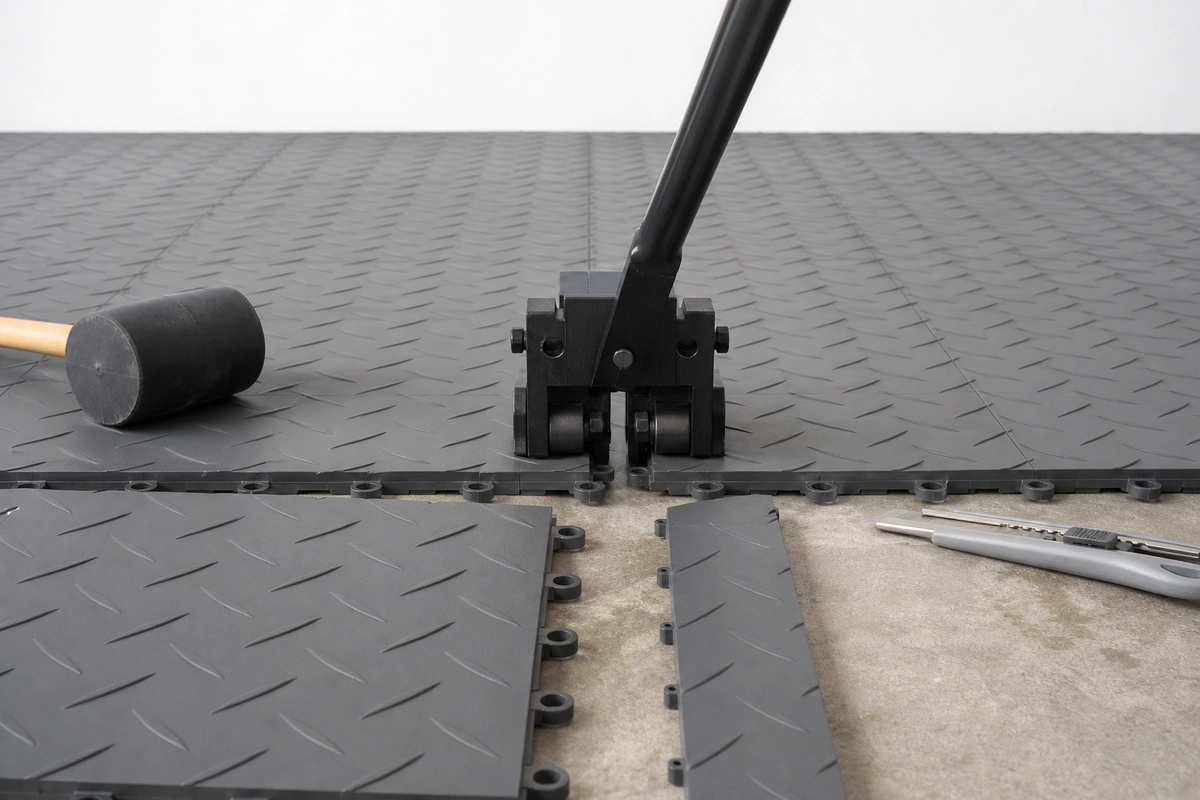
DIY Installation: Workshop Floor in One Afternoon
PVC interlocking tiles require zero special skills. If you can swing a rubber mallet, you can install these.
The skill that matters is reading the slab. For the universal concrete-prep checklist — moisture test thresholds, crack repair by width, flatness specs, and which floor types tolerate which slab conditions — see our installing flooring over concrete guide.
What you need:
- Rubber mallet
- Utility knife (for edge cuts)
- Tape measure
- Straight edge
Steps:
- Sweep the concrete — remove all debris, dust, and loose material
- Start from one corner — place first tile with interlocking tabs facing outward
- Work row by row — tap tiles together with the rubber mallet until they click
- Cut edge tiles — score with utility knife, snap along the line
- Add edge trim — attach beveled edges along exposed sides
Workshop-specific tips:
- Install tiles before moving heavy equipment in
- Leave a 1/4″ expansion gap along walls
- No adhesive needed — the floating system allows removal if you ever move
- Cut around floor drains or fixed obstacles with the utility knife
Total install time for a 400 sq ft workshop: 4-6 hours for one person. With a helper, cut that in half.
Want to know the best part? If you ever move workshops or rearrange your layout, pull the tiles up and reinstall them in the new configuration. Try doing that with epoxy.
Maintenance and Care
PVC workshop floors require almost zero maintenance.
Weekly: Sweep or shop-vac to remove sawdust, metal shavings, and debris. The diamond pattern traps less dust than you’d expect.
As needed: Mop with mild detergent for oil or chemical spills. PVC resists staining, so most spills wipe clean without scrubbing.
Damaged tiles: Pop out the damaged tile, snap in a replacement. No need to redo the entire floor.
No waxing. No sealing. No recoating. Ever.
Compare that to epoxy floors that need periodic recoating or concrete sealers that wear down over time. PVC tiles are genuinely maintenance-free for the life of the product.
FAQ — Workshop Flooring
What is the best flooring for a workshop?
PVC interlocking tiles offer the best balance of chemical resistance, durability, and DIY installation for workshops. They handle rolling loads up to 5,000 lbs and static loads up to 20,000 lbs while providing thermal insulation from cold concrete.
Is rubber or PVC better for a workshop floor?
PVC is better for full-floor workshop coverage. It resists chemicals more effectively, handles rolling carts without resistance, and hides sawdust better than rubber. Rubber works best as targeted anti-fatigue mats at standing workstations.
Can you put interlocking tiles over uneven concrete?
Yes, for minor imperfections. PVC tiles flex slightly to accommodate small dips and ridges. Major cracks (over 1/4″) or significant slopes should be repaired first. The floating install doesn’t require a perfectly level surface.
How thick should workshop floor tiles be?
Standard PVC workshop tiles are 0.25″ thick — sufficient for chemical protection, thermal insulation, and heavy loads. For anti-fatigue comfort at workbenches, add 0.79″ foam mats on top of PVC tiles.
Are interlocking tiles slippery when wet?
No. Diamond and coin patterns provide textured grip even when wet or oily. The raised surface channels liquids away from the walking surface. PVC tiles are specifically designed for environments where spills happen.
How do you protect workshop flooring from welding sparks?
PVC tiles are inherently fire-resistant and can handle occasional sparks. For heavy welding or grinding stations, place a fire-rated welding mat over the tiles in that zone. This protects the tiles from sustained heat exposure.
Can I drive a vehicle over PVC workshop tiles?
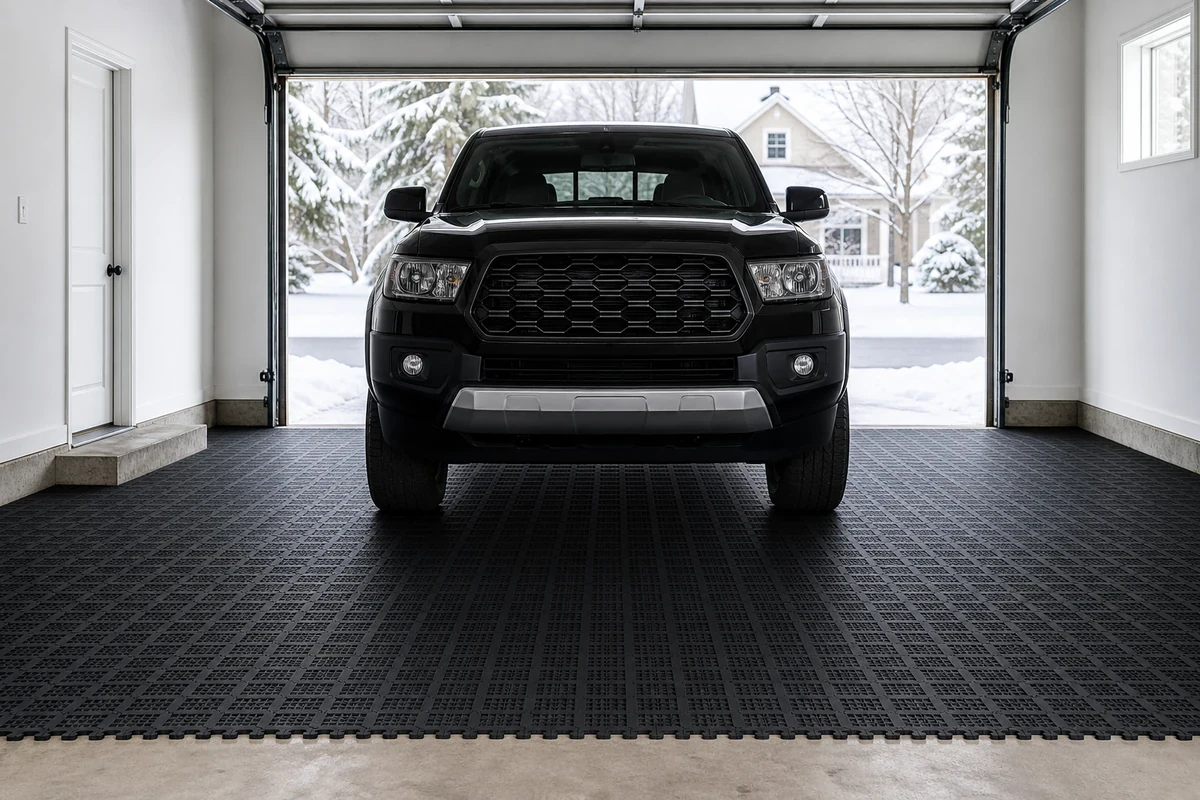
Yes. DURAFLEX Diamond tiles support 5,000 lbs rolling load — more than sufficient for passenger vehicles, motorcycles, and ATVs. For heavy trucks or vehicles over 5,000 lbs, consider reinforced options.
How long do PVC workshop floor tiles last?
DURAFLEX Diamond tiles come with a limited lifetime warranty and are built from industrial-grade PVC. Under normal workshop conditions — chemical exposure, foot traffic, equipment loads — expect 15-20+ years of service. Individual damaged tiles can be replaced without disturbing the rest of the floor.
Do PVC tiles work in unheated workshops?
Yes. PVC tiles maintain dimensional stability from -30°F to 120°F. They also provide thermal insulation between your feet and cold concrete — a significant comfort upgrade in winter months when bare concrete radiates cold.
Ready to Upgrade Your Workshop Floor?
Your knees, your tools, and your cleanup routine will all thank you.
For most workshops, DURAFLEX Diamond PVC Tiles are the smart choice — chemical resistant, heavy-load rated, and installable in a single afternoon.