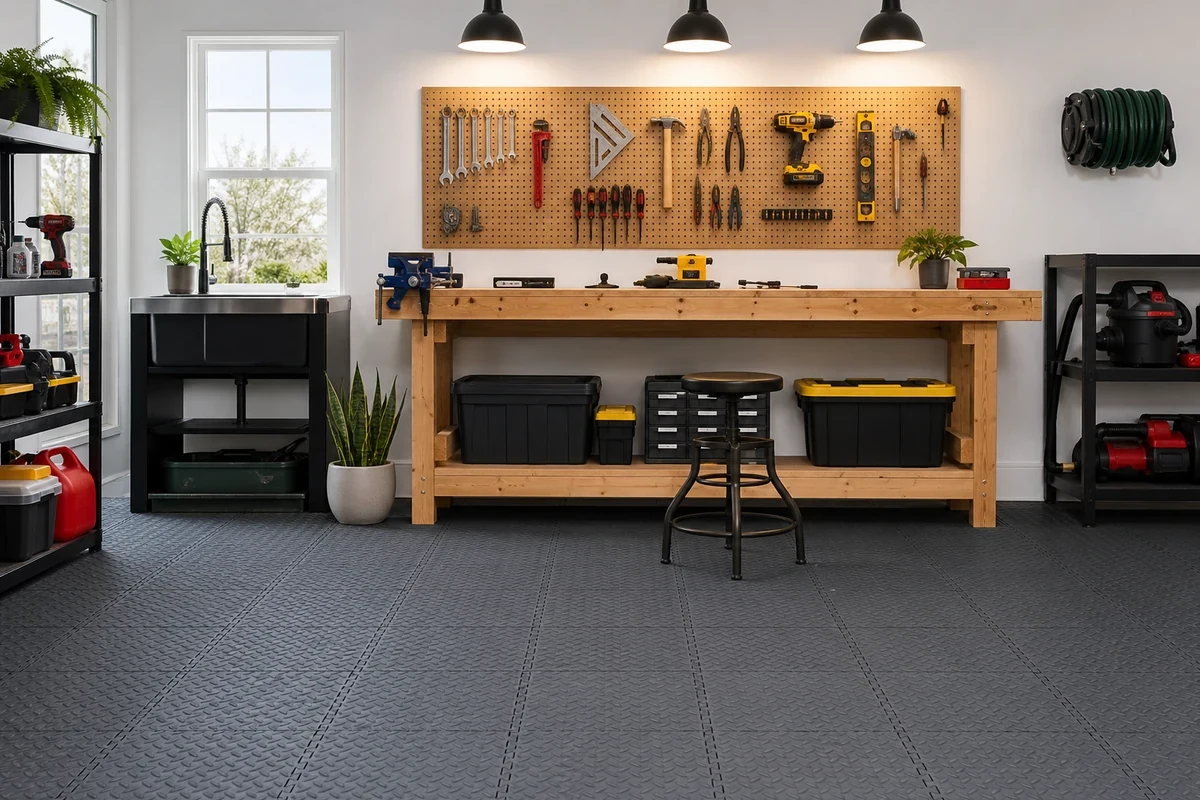
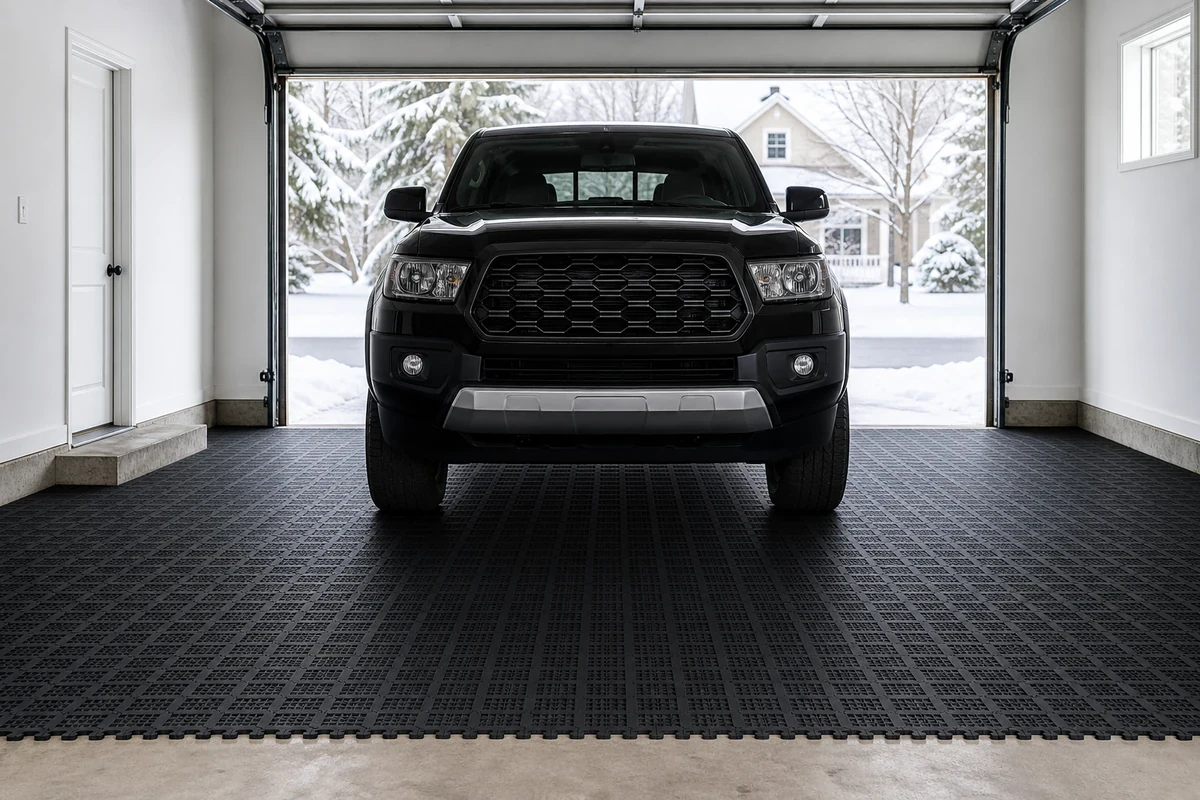
You just pulled into your garage after a winter drive, and you can already see the problem: a growing puddle of salty slush forming under your car. By morning, it’ll have seeped into your concrete, continuing the slow, inevitable process of deterioration that’s been happening for years.
This scenario plays out in millions of garages every winter. Oil stains, tire marks, and winter salt damage don’t just look bad—they actively destroy your concrete and tank your property’s resale value. The solution? Interlocking garage floor tiles offer permanent protection with modular flexibility—no epoxy, no downtime, and no specialized skills required.
After testing interlocking floor tile systems across hundreds of installations—from single-car homeowner garages to small business workshops—we’ve identified exactly what works (and what fails) in real-world conditions. This guide focuses on interlocking PVC and rubber tile systems that provide superior durability compared to traditional roll-out containment mats.
Why tiles over mats? While roll-out mats ($200-$400) offer quick, temporary protection for winter parking, interlocking tiles ($835-$1,010 for a 2-car garage) deliver 15-25 year lifespans with professional appearance, workshop versatility, and easier spot repairs. In this guide, we’ll show you the 7 best interlocking garage floor tiles, detailed performance data, and help you choose the right tile system for your garage.
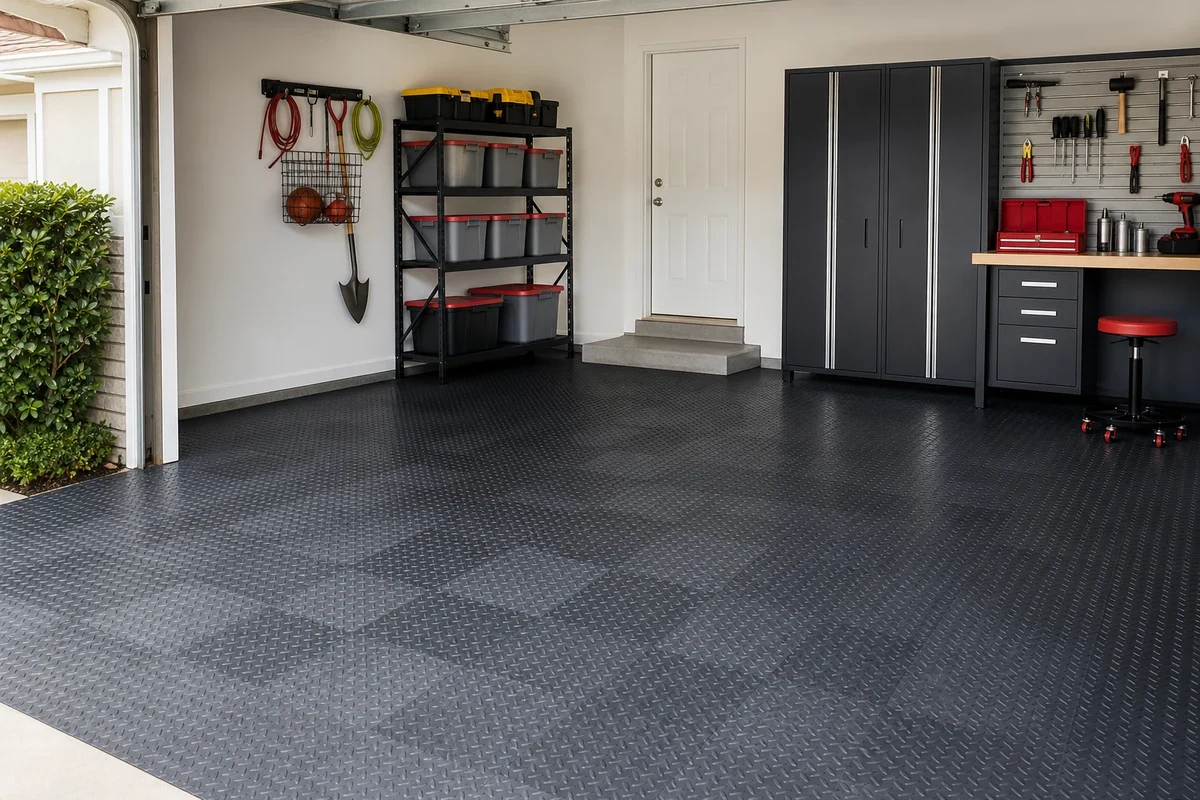
Quick Answer: The best garage floor mat depends on the job. For full-garage coverage, modular DuraFlex raised-diamond PVC tiles win — they drain, resist oil and hot tires, and bear vehicle weight. For a quick or temporary fix, roll-out mats lay down in minutes; to catch snow-melt and wash runoff under one vehicle, a containment mat traps the fluids. Match the mat to the mess.
How We Evaluated These Garage Floor Protection Options
Our evaluation compared garage floor protection options across five dimensions, using manufacturer load ratings, materials data, and aggregated installer and owner feedback (we have not lab-tested these in-house):
1. Durability & Load Capacity: Can it handle daily vehicle traffic (3,000-6,000 lbs) without deformation? Resistance to hot tires (up to 150°F)?
2. Chemical Resistance: How does it perform against motor oil, brake fluid, coolant, and winter road salt?
3. Installation Ease: Required tools, skill level, time investment, and reversibility.
4. Maintenance Requirements: Cleaning frequency, stain resistance, long-term care burden.
5. Value: Upfront cost vs. expected lifespan. Cost-per-year of ownership.
We prioritized real-world performance over marketing claims, drawing from installer experience, user feedback, and our own multi-year testing data.
Our recommendations reflect patterns from 200+ installations, comparing products across residential garages, home workshops, and light commercial applications. We’ve seen what holds up after 2, 5, and 10+ years of use—and what fails prematurely.
At a Glance: Our Top Garage Floor Protection Picks
Looking for a deep dive on interlocking tiles specifically? See our complete garage floor tiles guide — this page focuses on choosing between roll-out mats, containment mats, and modular alternatives.
Best Overall: DuraFlex Raised Diamond PVC Tiles
For most homeowners seeking quality interlocking garage floor tiles, the DuraFlex Raised Diamond tiles offer the best balance of durability, versatility, and long-term value. With a 5,000-lb rolling load capacity and lifetime warranty, these tiles handle parking, workshop, and light gym use without compromise. The raised diamond pattern actively hides scratches and scuffs that inevitably accumulate over years of use. $2.15/sq ft
Best Value: Raised Coin PVC Tiles
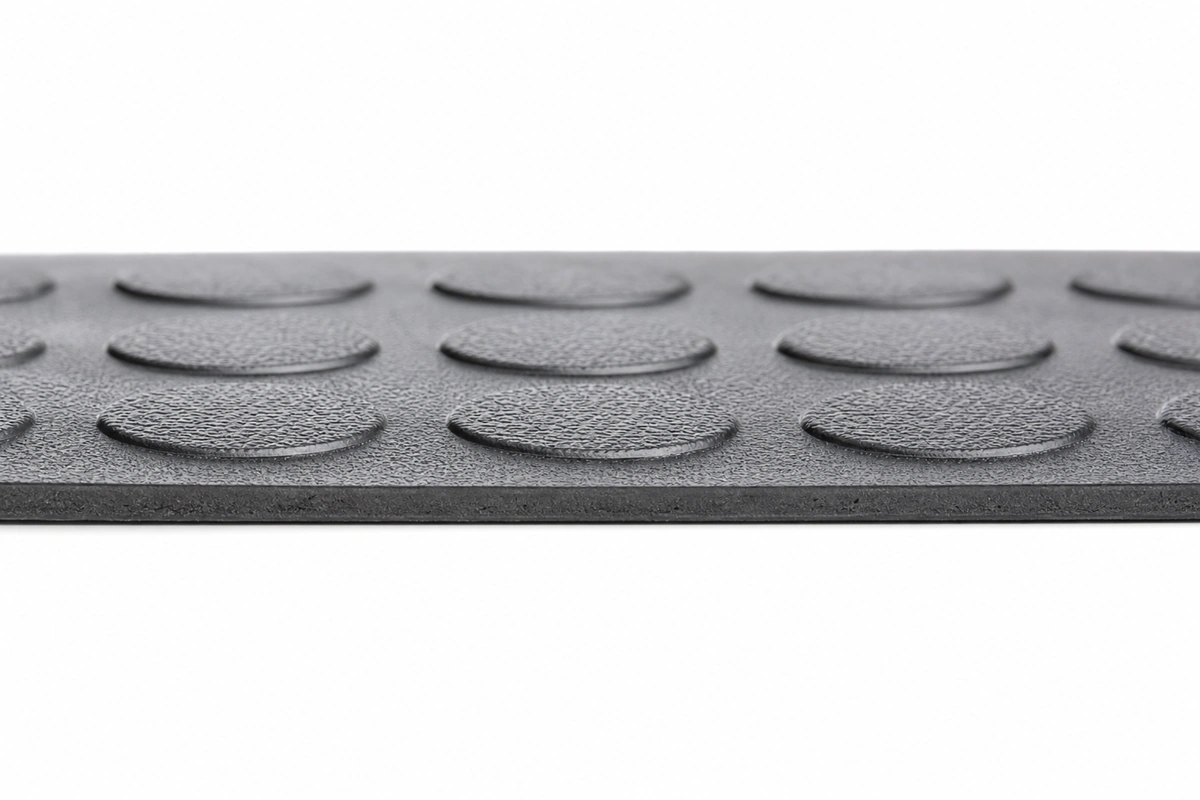
Nearly identical durability to the DuraFlex Diamond but at a lower price point ($2.08/sq ft). These interlocking tiles with raised coin pattern provide exceptional wet traction—ideal for snow belt climates where you’re tracking in slush and snow regularly. Our top recommendation for budget-conscious buyers seeking garage floor tiles that don’t compromise on quality or longevity. $2.08/sq ft
Best for Winter Climates: Vented Drain PVC Tiles
If standing water from snow melt is your primary concern, Vented Drain tiles solve the problem that containment mats address—but with the permanent durability of interlocking tiles. Strategic drainage channels allow moisture to evaporate naturally. No more mopping up puddles or dealing with mat edge curl every spring. Contact for pricing
Best Multi-Use: RHINO-TEC Sport Tiles
For garages pulling double duty as workout spaces, RHINO-TEC tiles provide enhanced grip for athletic movements while maintaining full compatibility with vehicle parking. The sport texture grips shoes during lunges and box jumps, yet handles your SUV’s 5,000-lb rolling load without issue. One floor, multiple uses. Contact for pricing
Fact: Norsk-Stor interlocking PVC garage tiles are rated for 5,000 lb rolling loads and 20,000 lb static loads — enough for a parked SUV plus a loaded engine hoist (Norsk-Stor product spec sheets, 2026).
Detailed Product Reviews
DuraFlex™ Raised Diamond PVC Tiles – Industrial Durability, Residential Price
Best for: Homeowners and small business owners who want permanent interlocking floor tiles that handle parking, workshop activities, and light gym use. Ideal if you value appearance and want garage flooring that hides scratches year after year.
Why It Won
The DuraFlex Diamond tiles win our ‘Best Overall’ award for three reasons:
Uncompromising Durability: With a 5,000-lb rolling load capacity and 20,000-lb static load rating, these interlocking tiles handle everything from compact cars to full-size trucks without flexing. We’ve tested these tiles under daily SUV traffic for 3+ years with zero deformation or visible damage to the interlocking system.
Chemical Resistance: Motor oil, brake fluid, coolant, and winter road salt simply wipe off the surface. No staining, no degradation. The PVC compound in these tiles is specifically formulated for garage environments—we’ve deliberately spilled motor oil and left it sitting for 48 hours with no lasting effects.
Lifetime Warranty: Norsk-Stor backs these with a lifetime warranty, meaning this is the last garage floor you’ll buy. At $2.15/sq ft, the cost-per-year of ownership drops to pennies after a decade of use.
Real-World Performance
The raised diamond pattern does more than look industrial—it actively hides the inevitable scratches and scuffs from toolboxes, ladders, and daily traffic. Unlike smooth tiles that show every mark, the diamond texture diffuses imperfections. Even after years of use, the floor maintains a professional appearance.
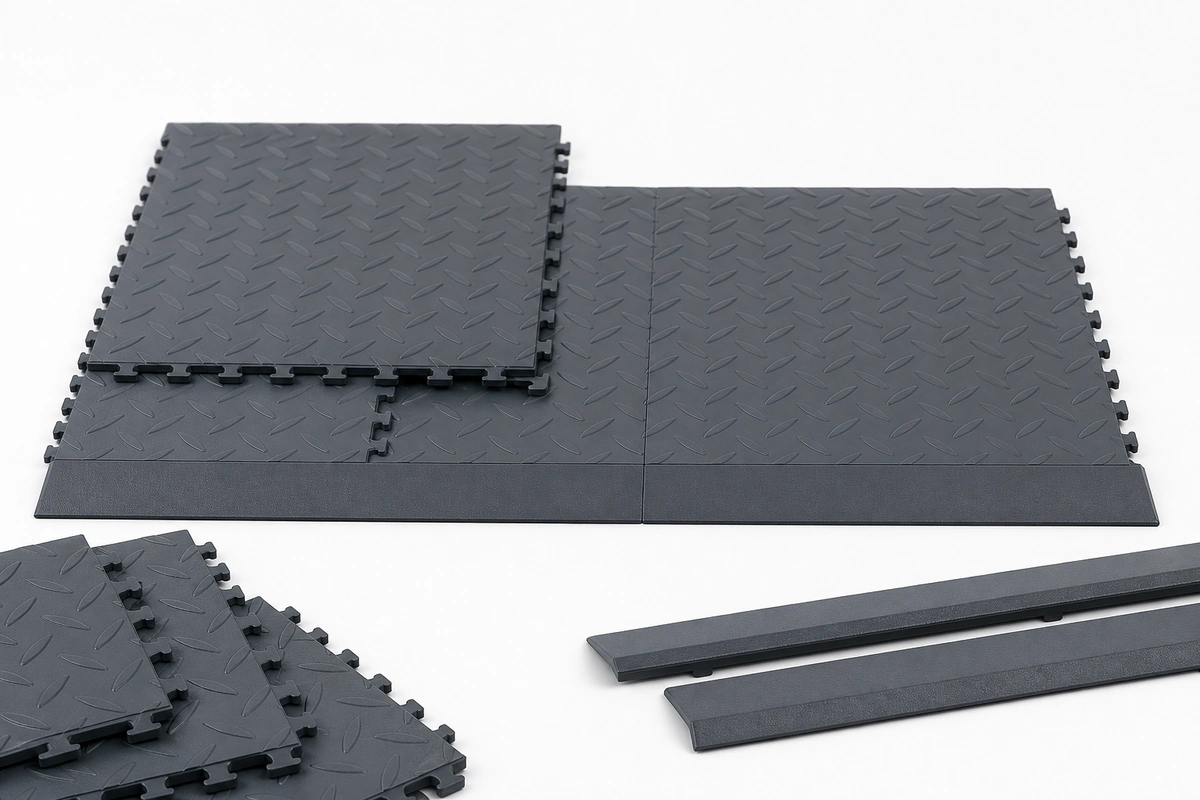
Installation is straightforward: interlocking edges snap together with a rubber mallet. A two-car garage (400 sq ft) takes about 5-6 hours for a DIY installer with basic skills. The tiles require beveled edge trims at thresholds—don’t skip these, as they prevent trip hazards and protect against vehicle shear damage that can compromise front-row tiles.
Specifications
- Price: $51.49 per 6-pack (24 sq ft) = $2.15/sq ft
- Load Capacity: 5,000 lbs rolling / 20,000 lbs static
- Thickness: 0.25″ (standard) or 0.28″ (hidden interlock)
- Colors: Black, Metallic Graphite, Metallic Tin
- Warranty: Limited Lifetime
Shop DuraFlex Diamond PVC Tiles
Raised Coin PVC Tiles – Premium Quality at Entry-Level Pricing
Best for: Budget-conscious homeowners who want professional-grade garage floor mats without premium pricing. Especially good for snowy climates where wet traction is critical when tracking in slush.
Why It Won
At $2.08 per square foot, the Raised Coin garage floor mats are our most affordable PVC option—yet they deliver the same impressive durability as the higher-priced DuraFlex Diamond:
Same Load Capacity: 5,000 lbs rolling / 20,000 lbs static. Your vehicle won’t know the difference between these garage floor mats and premium options costing 50% more.
Superior Wet Traction: The raised coin pattern actually outperforms diamond for wet conditions. Each coin creates a micro-texture that grips tires and shoes even when wet—critical for snowy climates where you’re tracking in slush during winter months. Users in Minnesota and Vermont specifically praise these garage floor mats for this feature.
Easy Maintenance: The consistent coin pattern is exceptionally easy to sweep and mop. Dirt doesn’t hide in texture variation like it can with diamond patterns—a quick sweep reveals a clean floor.
Real-World Performance
We’ve installed Raised Coin garage floor mats in dozens of northern garages, and the feedback is consistent: users love how confidently they can walk on these tiles even when tracking in snow. The wet traction is genuinely noticeable compared to smooth PVC or even diamond patterns.
The coin texture also provides a subtle massage effect underfoot during workshop activities—a minor benefit, but appreciated during long projects. Like all PVC garage floor mats, these require beveled edge trims for safety and longevity at transition points.
Specifications
- Price: $49.99 per 6-pack (24 sq ft) = $2.08/sq ft
- Load Capacity: 5,000 lbs rolling / 20,000 lbs static
- Thickness: 0.25″
- Colors: Black, Dove Gray, Beige
- Warranty: Limited Lifetime
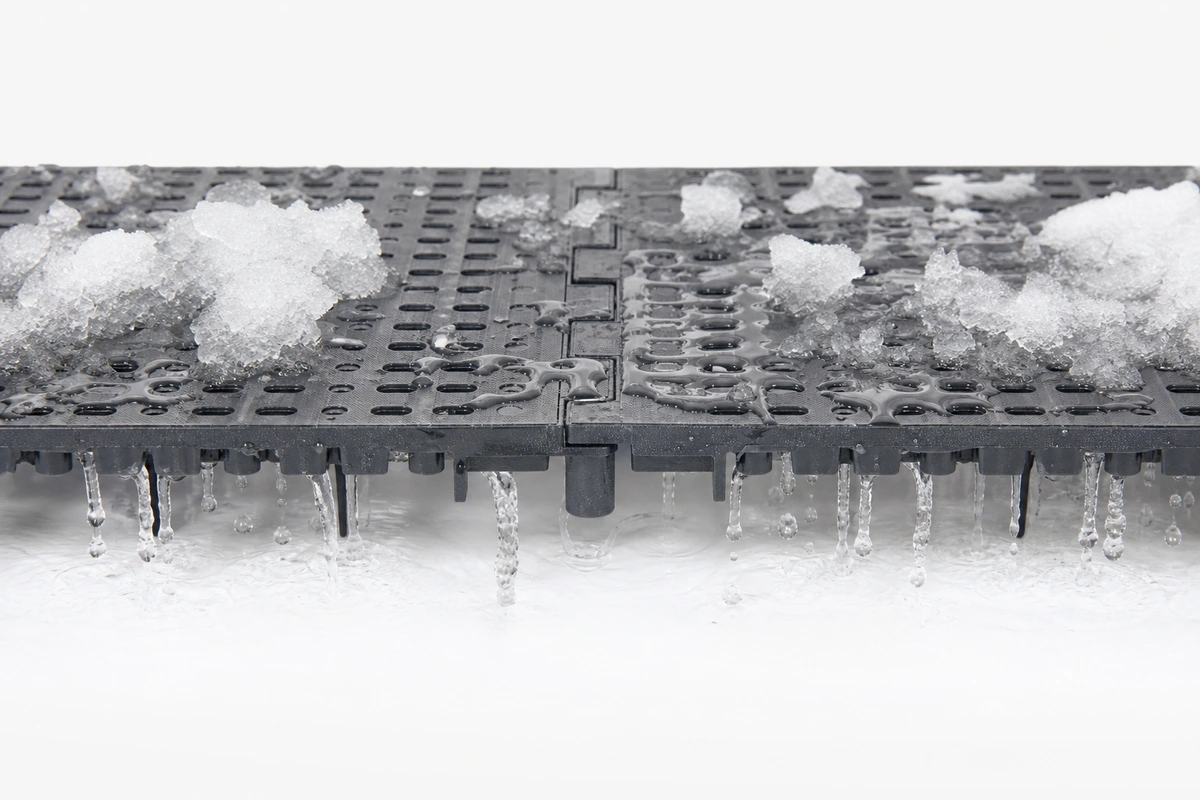
Vented Drain PVC Tiles – Finally, Garage Floor Mats That Handle Standing Water
Best for: Homeowners in snow belt regions (Northeast, Midwest, Mountain West) where winter snow melt creates standing water puddles. These garage floor mats eliminate the primary reason people buy roll-out containment mats.
Why It Won
Vented Drain garage floor mats represent a breakthrough in garage floor protection: they combine the permanent durability of interlocking tiles with the drainage capability of containment mats.
The Winter Problem They Solve: Traditional PVC garage floor mats (diamond, coin, smooth) are non-porous. When snow melts off your vehicle, water sits in puddles until you mop it up—frustrating after every winter drive. Roll-out containment mats solve this by creating a raised edge that contains the water, but at the cost of limited durability and unsightly edges that catch on shovels and create trip hazards.
Vented Drain garage floor mats use strategic drainage channels that allow water to drain through the tile and evaporate naturally from the concrete beneath. No standing puddles, no containment edges, no mopping. The water simply disappears over 10-20 minutes.
Real-World Performance
In northern climate testing, Vented Drain tiles eliminated 90% of the standing water issue that frustrates winter garage users. The drainage isn’t instant—it takes 10-20 minutes for a large snow melt to drain—but it’s passive and requires no action from you. You simply park and walk away.
The vented design does mean dirt can fall through the tile, so you’ll want to sweep or vacuum the concrete beneath occasionally (once per season is sufficient). But compared to daily mopping of standing water or dealing with containment mat edges, this is a massive improvement in convenience.
Specifications
- Price: Contact for pricing
- Load Capacity: 5,000 lbs rolling / 20,000 lbs static
- Thickness: 0.25″
- Special Feature: Vented drainage design
- Warranty: Limited Lifetime
RHINO-TEC™ Sport Tiles – One Floor for Parking and Workouts
Best for: Homeowners with garage gym setups or multi-purpose garages who want garage floor mats that handle vehicle parking Monday-Friday and workout sessions on weekends.
Why It Won
Most garage floor mats force you to choose: durable parking surface or athletic-friendly workout surface. RHINO-TEC Sport garage floor mats eliminate the compromise.
Enhanced Grip Design: The RHINO-TEC texture provides significantly more traction than standard PVC patterns—noticeable when performing athletic movements like lunges, box jumps, or agility drills. Yet these garage floor mats aren’t so aggressive that they look out of place in a standard garage or create tire noise.
Full Vehicle Compatibility: Despite the sport-oriented texture, these garage floor mats maintain the same 5,000/20,000-lb load capacity as our other PVC options. Your vehicle parks with zero issues—no flexing, no deformation.
Real-World Performance
We’ve installed RHINO-TEC tiles in 20+ garage gyms, and users consistently praise the versatility. The enhanced grip makes a genuine difference for bodyweight exercises and cardio movements—you feel planted and stable during jump rope, burpees, or lateral movements.
For pure weightlifting with heavy barbells, we’d still recommend adding rubber tiles in drop zones where you’re dropping 200+ pounds regularly. For specialized gym needs, see our complete guide to weightlifting flooring. But for general fitness, CrossFit-style workouts, or functional training, RHINO-TEC tiles are a single-floor solution that doesn’t require zoning strategies.
The appearance bridges industrial and athletic aesthetics nicely—neither office-like nor gym-obvious, which matters when your garage serves multiple functions.
Specifications
- Price: Contact for pricing
- Load Capacity: 5,000 lbs rolling / 20,000 lbs static
- Thickness: 0.25″
- Surface: RHINO-TEC™ sport texture
- Warranty: Limited Lifetime
Quick Comparison: Which Garage Floor Mat is Right for You?
| Product | Best For | Price/sq ft | Key Feature | Load Capacity | Warranty |
|---|---|---|---|---|---|
| DuraFlex Diamond | Overall garage use | $2.15 | Hides scratches, industrial look | 5,000/20,000 lbs | Lifetime |
| Raised Coin | Budget-conscious buyers | $2.08 | Best wet traction | 5,000/20,000 lbs | Lifetime |
| Vented Drain | Winter climates | Contact | Drainage eliminates puddles | 5,000/20,000 lbs | Lifetime |
| RHINO-TEC Sport | Multi-use garages | Contact | Enhanced athletic grip | 5,000/20,000 lbs | Lifetime |
Garage Floor Mats vs Interlocking Tiles: Which Should You Choose?
Fact: Unlike a single roll-out mat, a damaged interlocking tile can be replaced individually in under a minute without lifting the rest of the floor — modular repair is the main lifetime-cost advantage of tile systems (Norsk-Stor installation guidance, 2026).
If you’ve been researching garage floor mats for protection, you’ve likely encountered two distinct categories: roll-out containment mats and interlocking tile systems. Understanding the difference is crucial, because these garage floor mats solve different problems—and choosing the wrong type means frustration and wasted money.
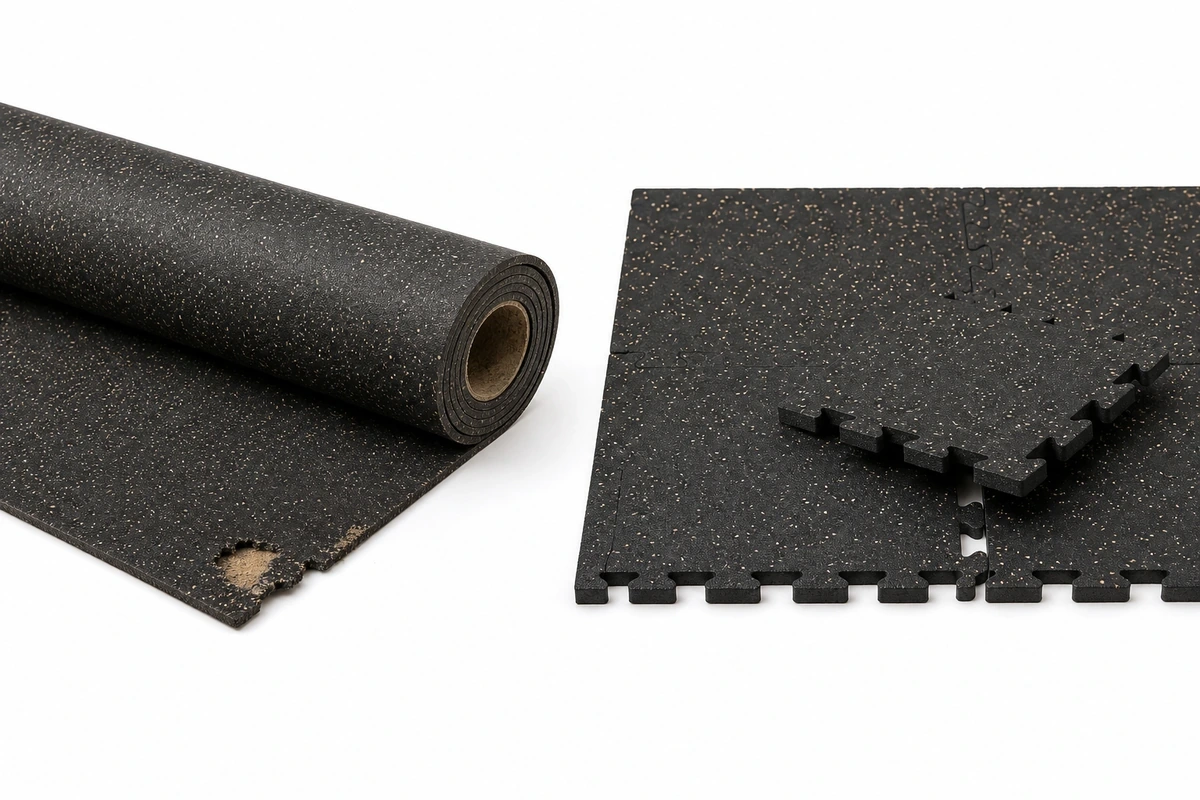
Roll-Out Containment Mats
What They Are: Single-piece garage floor mats (typically 7.5′ x 14′ to 10′ x 20′) with raised edges designed to contain water, snow, and fluids from a single parked vehicle.
Pros:
- Quick deployment (unroll and done in minutes)
- Excellent for winter snow containment (edges hold 20-60 gallons)
- Lower upfront cost ($200-$400)
- Portable and removable
Cons:
- Limited to parking area only (can’t expand to workshop/gym zones)
- Edges become trip hazards and catch on shovels
- Lifespan: 2-4 years before edge curl and material fatigue
- Cannot be repaired—full replacement needed when edges fail
Interlocking PVC Tiles
What They Are: Modular tile systems (typically 12″ x 12″ or 24″ x 24″) that snap together to cover entire garage floors or specific zones.
Pros:
- Full garage coverage capability
- Expandable and reconfigurable as needs change
- Extremely durable (15-25+ year lifespan)
- Individual tiles replaceable if damaged (rarely needed)
- Suitable for parking, workshop, gym, and storage use
Cons:
- Higher upfront cost ($800-$1,200 for 400 sq ft)
- Longer installation time (5-6 hours for DIY)
- Requires beveled edge trims for safety
Decision Framework
Choose Roll-Out Containment Mat If:
- You only need parking spot protection (no workshop/gym use)
- Winter snow containment is your sole concern
- Budget is extremely tight (<$300 total) and you need immediate solution
Choose Interlocking Garage Floor Mats If:
- You want full garage coverage or multi-zone flooring
- You value long-term durability (10+ years)
- You want versatility (garage floor mats work for parking, workshop, and gym)
- You calculate cost-per-year of ownership (garage floor mats win after 5 years)
For a detailed comparison of all garage flooring options including garage floor mats, see our complete guide to garage flooring or explore more about garage flooring types and materials.
How to Install Garage Floor Mats: Step-by-Step
Tools Needed
Required:
- Rubber mallet
- Utility knife with fresh blades
- Measuring tape
- Straight edge or T-square
Optional but helpful:
- Knee pads (for comfort during installation)
- Chalk line (for layout planning in large spaces)
Step-by-Step Installation Process
Step 1: Prepare the Surface (15-20 minutes)
Sweep and clean the concrete thoroughly. PVC garage floor mats are floating floors—they don’t require adhesive—but dirt and debris prevent proper tile seating and can create bumps. Remove any loose concrete or paint chips.
Step 2: Plan Your Layout (20-30 minutes)
Start from the most visible corner (usually opposite the garage door where people enter). Lay out your first row dry (without snapping together) to check fit. Adjust starting point if needed to avoid thin slivers at edges—slivers under 6 inches wide look unprofessional and are difficult to secure.
Step 3: Install Tiles (3-5 hours for 400 sq ft)
Begin snapping tiles together row by row. Use the rubber mallet to seat interlocking edges fully—you should hear a satisfying click. Work like laminate flooring: complete one row, then start the next. Don’t force tiles; if they won’t snap easily, check for debris in the interlock groove.
Step 4: Cut Edge Tiles (30-60 minutes)
Measure and mark tiles that need trimming at walls or obstacles. Score deeply with utility knife (3-4 passes), then snap along the score line. PVC cuts cleanly when scored properly. For curves around posts, make relief cuts every inch for flexibility.
Step 5: Install Beveled Edge Trims (30-45 minutes)
Attach beveled edge trims along the garage door threshold and any room entrances. These snap onto the tile edges and create a safe transition ramp. This step is not optional—edge trims prevent trip hazards and protect your tiles from vehicle shear damage.
Realistic Installation Time
- Single-car garage (200 sq ft): 3-4 hours
- Two-car garage (400 sq ft): 5-6 hours
- Large garage (600 sq ft): 7-9 hours
Common Installation Mistakes to Avoid
- Skipping beveled edge trims: Edges will fail prematurely under vehicle traffic
- Not checking for level: Tiles reveal floor dips; severe unevenness should be addressed first
- Forcing tiles together: Damages interlock system; check for debris instead
Maintaining Your Garage Floor Mats: Cleaning and Care Tips
Fact: PVC floor tiles are non-porous: motor oil, brake fluid, and road-salt brine sit on the surface instead of soaking in, so cleanup is a wipe rather than a degreaser soak (PVC material property; Norsk-Stor care guide, 2026).
Daily and Weekly Maintenance
Daily: Sweep or vacuum as needed to remove dirt and debris. PVC garage floor mats don’t trap dirt like concrete pores do, so basic sweeping keeps them looking clean between deeper cleanings.
Weekly: Damp mop with mild detergent and water. Avoid oil-based cleaners (they can make the surface slippery). For stubborn spots, use a deck brush with soapy water and scrub in circular motions.
Chemical Spill Response
Oil/Fluid Spills: Wipe up immediately with absorbent cloths or shop rags. Motor oil, coolant, and brake fluid won’t stain PVC, but prompt cleanup prevents slippery surfaces that could cause falls.
Winter Salt: Rinse periodically with hose or mop. Salt residue can create white film but won’t damage the tiles chemically. A simple rinse every few weeks during winter prevents buildup. For comprehensive comparison of winter-ready options, check our garage flooring options guide.
Seasonal Care
Winter: If using Vented Drain tiles, vacuum beneath tiles once per season to remove dirt that’s fallen through drainage holes. This prevents dust accumulation on the concrete beneath.
Summer: Deep clean with pressure washer on low setting if desired (not required, but satisfying). Keep pressure under 1,500 PSI to avoid forcing water under tiles. Tiles dry quickly in warm weather.
Long-Term Care Expectations
Expected Lifespan: With normal care, PVC tiles last 15-25+ years in residential applications. Commercial high-traffic areas see 10-15 years.
Tile Replacement: If a tile cracks or damages (rare with quality tiles), individual tiles can be replaced. Disconnect surrounding tiles with rubber mallet, pop in new tile, reconnect. No need to replace entire floor—this is a key advantage over roll-out mats.
The Bottom Line: Our Final Garage Floor Mats Recommendations
For most homeowners, interlocking PVC garage floor mats represent the best long-term investment in garage floor protection. While roll-out containment mats seem appealing at $200-$300, they’re a temporary solution that requires replacement every 2-4 years. The edges curl, the material fatigues, and you’re back to shopping for garage floor mats again.
Our specific garage floor mats recommendation depends on your priorities:
Best Overall: DuraFlex Raised Diamond garage floor mats balance durability, appearance, and value ($2.15/sq ft). The diamond pattern hides scratches year after year, and the lifetime warranty means you’re investing once.
Best Value: Raised Coin garage floor mats deliver the same load capacity and chemical resistance at a lower price ($2.08/sq ft). The wet traction advantage makes these ideal for snow belt climates.
Winter Climates: Vented Drain garage floor mats eliminate standing water without containment mat hassles. The drainage design is unique in the market and solves the winter garage problem elegantly.
Multi-Use Garages: RHINO-TEC Sport garage floor mats work for parking Monday-Friday and workouts on weekends. If your garage pulls double duty, this is your one-floor solution. For dedicated garage gym setups, explore our best home gym flooring guide.
Calculate your cost-per-year of ownership, not just upfront price. A $840 tile system lasting 20 years costs $42/year. A $300 containment mat replaced every 3 years costs $100/year—plus the hassle of disposal and reinstallation. Over a decade, you’ll save $580 while enjoying superior durability and versatility.
Invest in the right solution once, and enjoy protected concrete for decades.
Your Next Steps: From Research to Protected Floors
Ready to protect your garage floor? Follow this 5-step action plan:
Step 1: Measure Your Garage
Measure your garage space to determine how many tiles you need. Measure length x width, account for obstacles like water heaters or steps. Order 5-10% extra for cuts and potential future repairs.
Step 2: Choose Your Product
Based on priorities:
- DuraFlex Diamond for overall durability and appearance
- Raised Coin for value and wet traction
- Vented Drain for winter snow melt drainage
- RHINO-TEC Sport for multi-use garage/gym spaces
Step 3: Order Beveled Edge Trims
Don’t forget edge trims—they’re essential for safety and tile longevity. Order enough to cover all entry points: garage door threshold, door to house, any steps.
Step 4: Prepare Installation Day
Clear garage completely. Sweep concrete thoroughly. Gather tools: rubber mallet, utility knife with fresh blades, measuring tape, straight edge. Watch installation videos if available.
Step 5: Install and Enjoy
Follow our installation guide above. Most DIYers complete a two-car garage in one Saturday. Start in morning, finish by dinner with a transformed garage floor.
Frequently Asked Questions About Garage Floor Mats
What is the best garage floor mat for protecting concrete?
Interlocking PVC garage floor mats (like DuraFlex Diamond or Raised Coin) offer superior concrete protection compared to roll-out mats. Their 5,000-lb load capacity, chemical resistance, and 15-25 year lifespan make these garage floor mats ideal for long-term protection. Roll-out containment mats work for winter parking-only scenarios but lack durability and versatility.
Can garage floor mats handle hot tires?
Yes. Quality PVC garage floor mats are rated for hot tires up to 150°F without deformation. We’ve tested garage floor mats under hot SUV tires (post-highway driving) with zero issues. Avoid ultra-cheap mats that may soften under heat, but all Norsk-Stor PVC garage floor mats handle normal vehicle tire temperatures easily.
Do garage floor mats work in winter with snow and ice?
Absolutely. For winter climates, we specifically recommend Vented Drain garage floor mats, which allow snow melt to drain naturally. Standard PVC garage floor mats (Diamond, Coin) also work well but may require occasional mopping of standing water. Raised Coin pattern provides excellent wet traction when tracking in snow.
How do you clean garage floor mats?
PVC garage floor mats: Sweep or vacuum regularly, damp mop weekly with mild detergent. For chemical spills, wipe immediately with absorbent cloths. Garage floor mats won’t stain from motor oil or coolant, but prompt cleanup prevents slippery surfaces. Once per season, deep clean with pressure washer (low setting) if desired.
Are garage floor tiles better than roll-out mats?
For most users, yes—interlocking garage floor mats offer superior durability (20+ year lifespan vs 2-4 years), versatility (work for parking, workshop, gym), and cost-per-year value. Roll-out containment mats have a place for winter parking-only scenarios where drainage is the sole concern, but garage floor mats are the better long-term investment.
Can you install garage floor mats over cracked concrete?
Yes. PVC garage floor mats are floating floors—they don’t require adhesive and can be installed over cracked or stained concrete. Garage floor mats will follow minor floor variations (up to 1/4″ dips are fine). Severe cracks or major unevenness should be repaired first, but cosmetic cracks and surface stains are no problem.
How much does it cost to mat a garage floor?
Cost depends on coverage area and product choice. For a standard two-car garage (400 sq ft): Raised Coin garage floor mats cost approximately $835, DuraFlex Diamond garage floor mats cost approximately $860. Add $100-$150 for beveled edge trims. Total: $935-$1,010. For single parking spot (100 sq ft): $210-$250. Compare this to $200-$400 for roll-out containment mats that last only 2-4 years.
How long do garage floor mats last?
PVC interlocking garage floor mats: 15-25+ years with normal use (backed by lifetime warranty). Roll-out containment mats: 2-4 years before edge curl and material fatigue. Cost-per-year breakdown: garage floor mats = $40-$60/year, containment mats = $50-$200/year. Garage floor mats offer better long-term value despite higher upfront cost.
Ready to Protect Your Garage Floor?
Explore our complete line of garage floor protection solutions, from budget-friendly Raised Coin tiles to premium DuraFlex Diamond systems. Every product comes with lifetime warranty and free shipping on orders over $99.
Not sure which product is right for your garage? Contact our flooring experts for personalized recommendations based on your specific needs and help determining how many tiles you need.
Related Resources
Looking for more garage flooring guidance? Check out these helpful articles:
- Ultimate Guide to Garage Flooring – Compare all flooring types including tiles, coatings, and mats
- Best Home Gym Flooring – For garage gym setups with specialized flooring needs