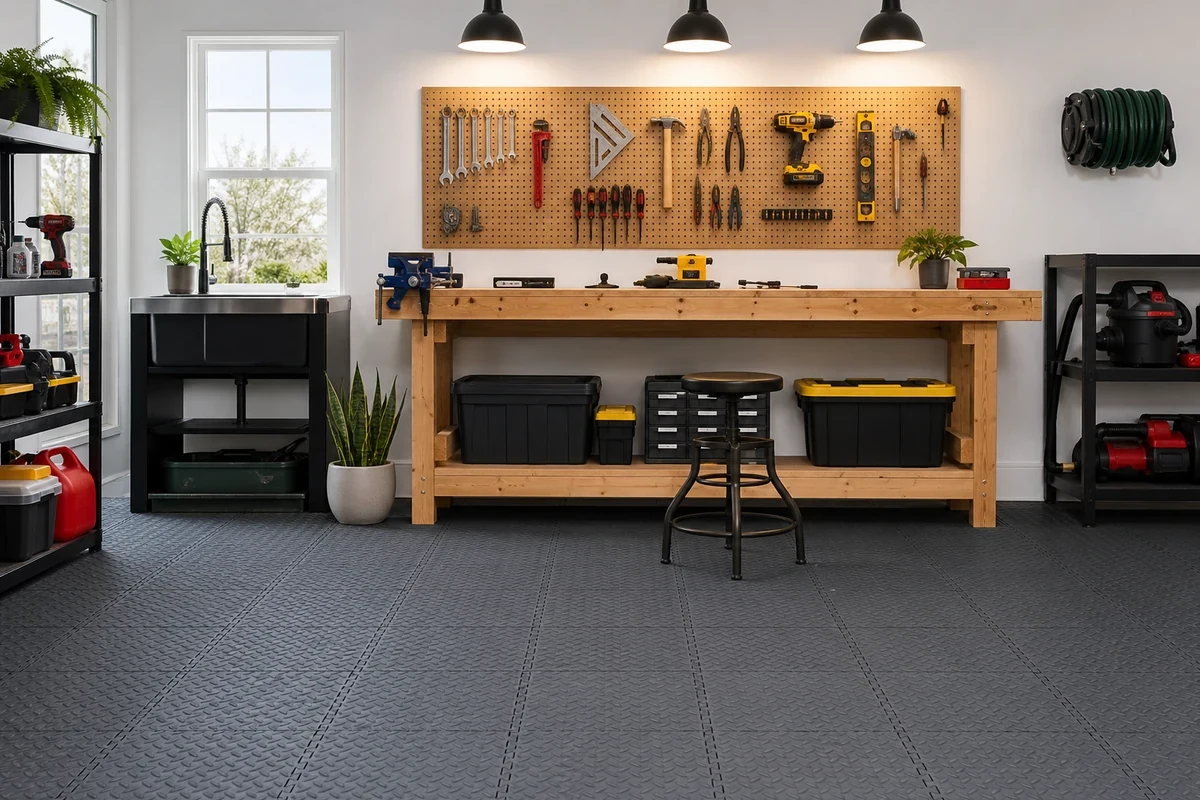
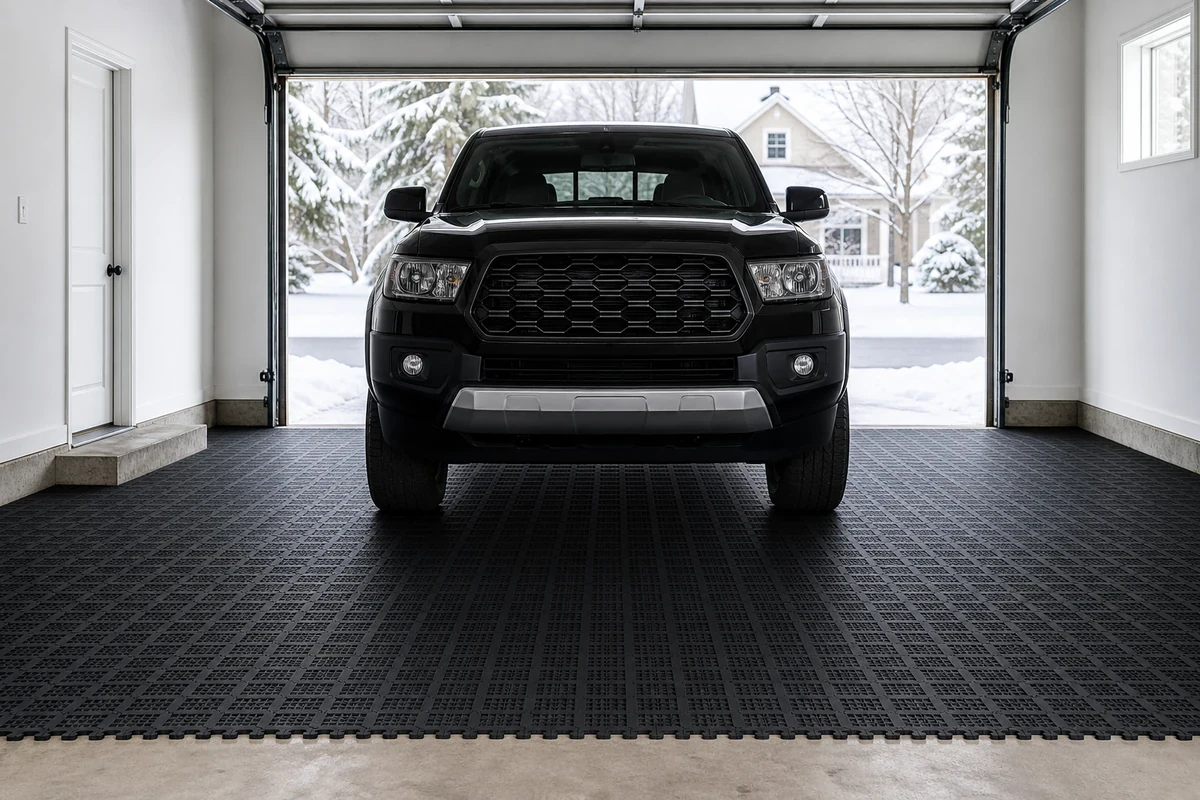
At a glance: Choosing the right garage flooring matters—most homeowners get the best balance of speed, durability, and future repairs with interlocking PVC tiles as their garage floor covering. Roll‑out mats win the “fastest makeover” prize but trail on edging and spot repairs. Coatings deliver a continuous look yet demand prep, cure time, and skill. This guide makes the call based on how you really use your bay—daily driving, projects, and people moving through the space.
When planning your garage flooring project, you face three main options: interlocking PVC tiles, roll-out mats, and coatings. This guide compares all garage floor covering types based on real-world garage conditions—daily parking, chemical exposure, and imperfect concrete slabs.
Quick Answer: Garage flooring comes down to three options. Interlocking PVC tiles are the best all-around choice — durable, DIY-friendly, and they bridge minor slab cracks. Roll-out mats are the cheapest, fastest temporary cover. Epoxy and polyurea coatings give the most seamless finish but demand careful prep and days of cure time. Tiles suit most homeowners; coatings suit those set on a permanent bonded surface.
What garage flooring actually faces in daily use
- Fluids & salts: Oil drips, coolant, brake fluid, winter brine—surfaces need real chemical resistance.
- Imperfect slabs: Hairline cracks, minor spalls, and stains are common. A floating surface should bridge and hide them.
- Loads & tire twist: Parked vehicles compress the leading row; turning tires test the lock strength.
- Cleanability & noise: The right texture hides scuffs and reduces the “hollow” slab sound that makes garages feel harsher than they should.
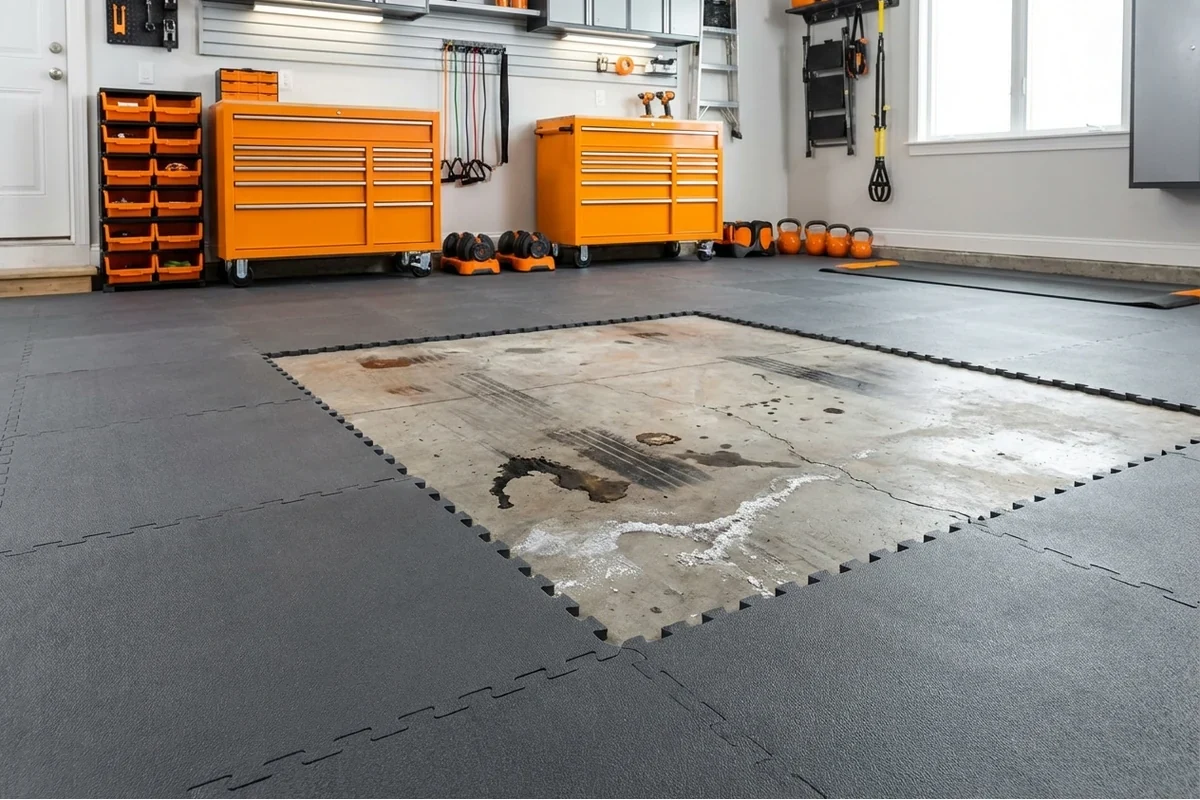
Option 1 — Interlocking PVC Garage Floor Tiles (the practical default)
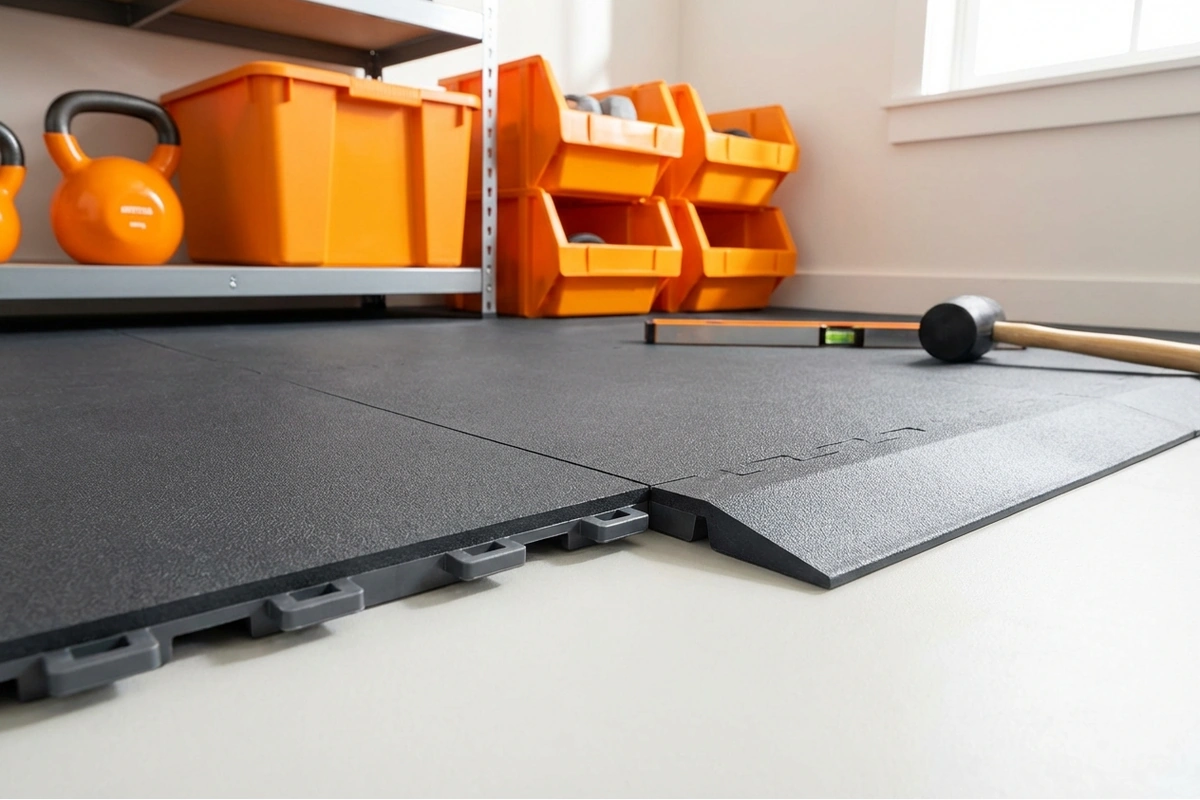
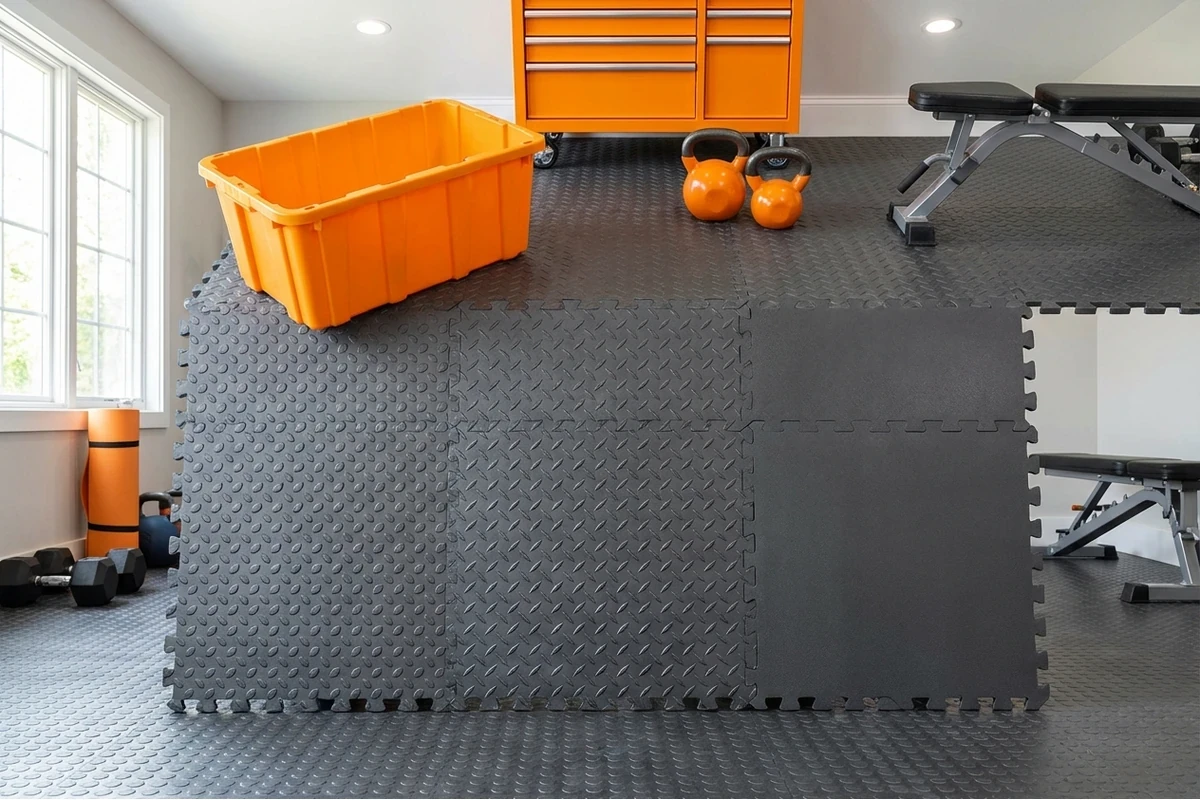
PVC tiles build a floating surface: no glue, no mess, and easy replacement when life happens. They lock tile‑to‑tile with teeth engineered to resist separation under parked loads and tire twist. Good systems also include beveled trims for door thresholds so the finished edge becomes a safe, low ramp.
Pros
- DIY‑friendly: Installs with a rubber mallet and utility knife.
- Bridges defects: Lays over minor slab flaws and old stains.
- Chemical resistant: Stands up to common automotive fluids.
- Repairable: Swap one damaged tile instead of re‑doing the bay.
- Design control: Choose textures (Raised Coin, Raised Diamond, smooth/low‑gloss) and colors for borders or lanes.
- Comfort & acoustics: Adds thermal and acoustic insulation vs. bare concrete.
Cons
- Upfront boxes to move: Tiles come in cartons; there’s some handling.
- Edge finishing matters: You must add beveled trims where foot traffic or tires cross—skipping them shortens the life of the front course.
What to look for
- Lock design & thickness: Standard visible‑tooth tiles are typically about .25″ thick; hidden‑interlock systems step up to ~.28″ for added strength and a seam‑like look. Use one system per install (teeth and trims are not cross‑compatible).
- Textures:
- Raised Coin = consistent micro‑grip in wet conditions.
- Raised Diamond = industrial look, hides scuffs well.
- Smooth/low‑gloss (e.g., leather‑like) = fast sweeping near work benches.
- Beveled trims & corners: Proper ramp pieces at the garage door and interior thresholds prevent tripping and protect tile edges from tire shear. For detailed product reviews and specific recommendations, see our best interlocking garage floor tiles guide.
Option 2 — Roll-out Garage Floor Mats (speed first)
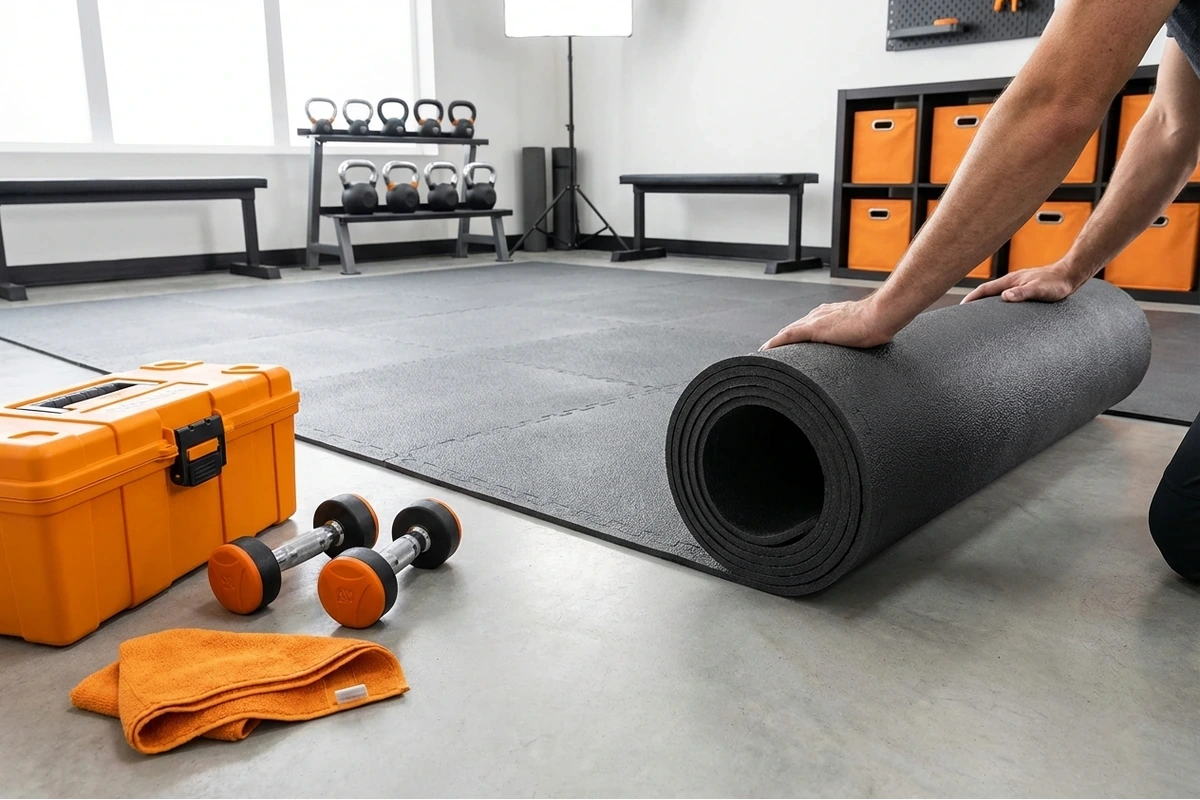
Big sheets roll down quickly and cover stains in minutes. They’re great for a fast spruce‑up or temporary coverage during a renovation.
Pros
- Fastest install: Roll, trim, done.
- Basic spill control: Contain drips and track‑in grime.
Cons
- Edge limitations: Clean, safe threshold ramps are harder to achieve.
- Spot repairs: Damaged areas often mean replacing a large section.
- Movement & ripples: Temperature changes may telegraph as slight waves if the slab isn’t very flat.
Best fit
- Photo day, home sale touch‑ups, or a low‑traffic bay that needs cosmetic improvement more than long‑term serviceability.
Option 3 — Garage Floor Coatings (epoxy, polyaspartic) — context only
Coatings can look seamless and glossy, but they are surface‑preparation projects. Success depends on grinding/etching, moisture testing, mixing accuracy, and cure‑window timing. If you like DIY that behaves like body‑work, coatings can shine; otherwise, tiles are the safer bet.
Pros
- Continuous film: No seams; easy sweeping.
- Additives available: Colored flakes, slip‑resistant media.
Cons
- Prep & cure: Dust, time, and tools; moisture can cause adhesion issues.
- Repair difficulty: Patching blends can be visible; large failures are expensive.
- Not slab‑forgiving: Visible telegraphing of cracks and patches without serious prep.
Quick Comparison: Garage Flooring Options at a Glance
| Option | DIY Speed | Chemical Resistance | Over imperfect slab | Spot Repairability | Threshold Safety | Parked Vehicles |
|---|---|---|---|---|---|---|
| PVC tiles | Fast | High | Yes | Excellent (1 tile) | Bevel kits | Yes |
| Mats | Fastest | Medium | Yes | Fair (large swap) | Limited | Sometimes |
| Coatings | Slow | High (with prep) | No (needs prep) | Hard | N/A | Yes |
Decision Flow: Pick the Best Garage Flooring by Use Case
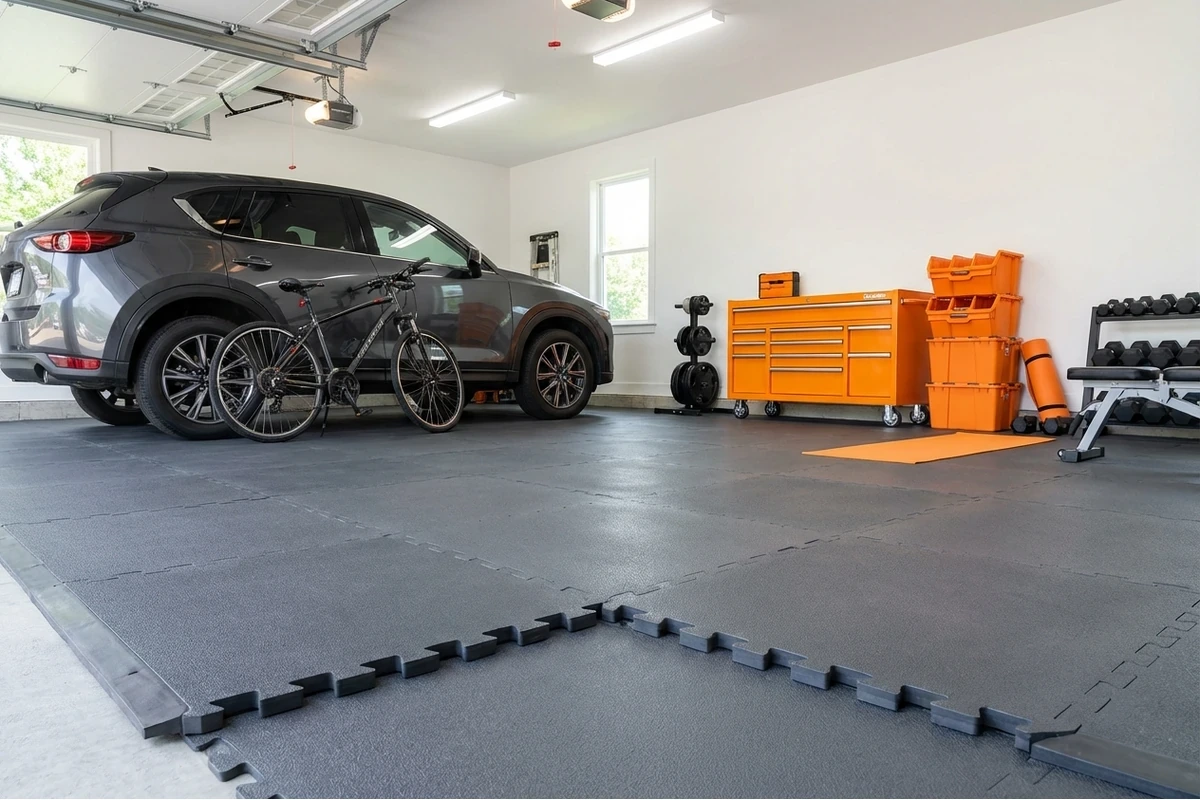
If any of the following are true, choose PVC tiles:
- You park daily or turn tires inside the bay.
- The slab has visible cracks/stains you’d rather not resurface.
- You want a weekend project with clean edges and no glue.
- You care about repairability down the road.
If you only need cosmetic coverage fast: roll‑out mats.
If you prioritize a continuous glossy look and accept pro‑level prep: coatings.
Pattern & texture: Coin vs. Diamond vs. Smooth
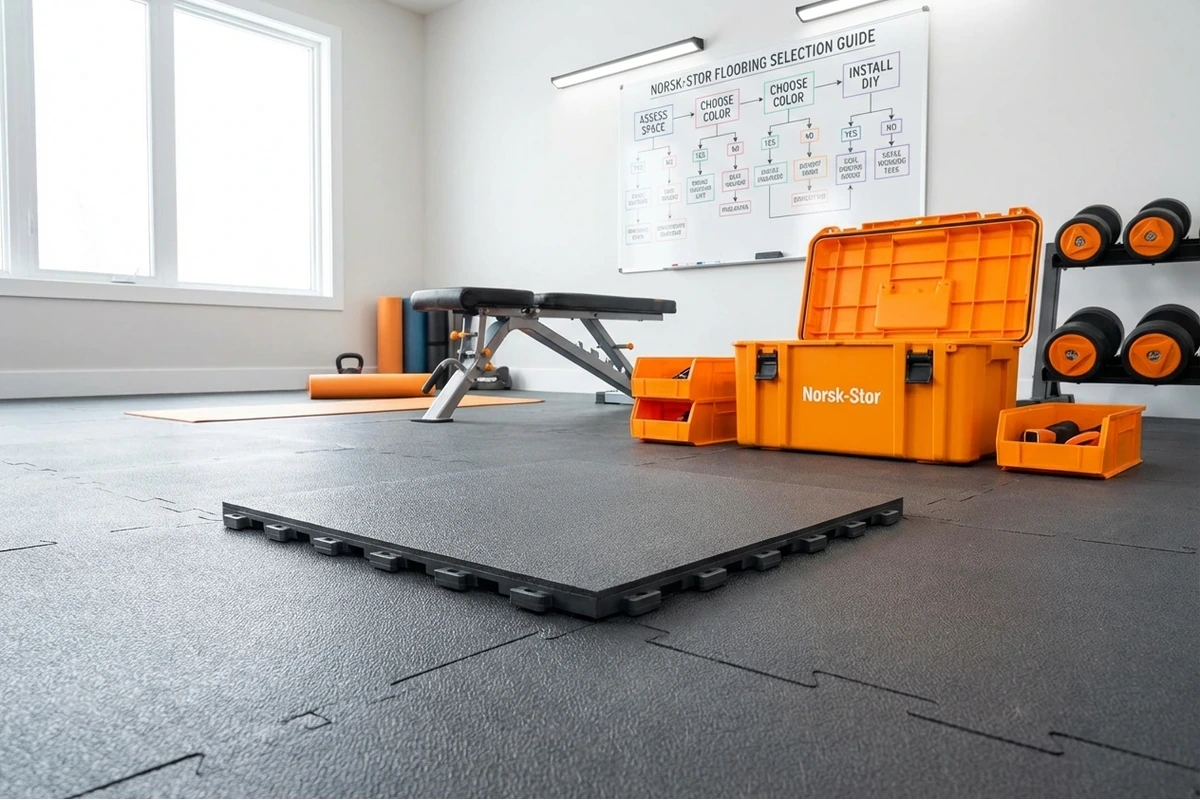
Traction
- Coin provides predictable grip in wet conditions (rain, snow melt).
- Diamond has broader facets—good traction, industrial vibe.
- Smooth/low‑gloss sweeps fast but is best away from the front drip line.
Cleanup & scuff hiding
- Diamond hides scuffs and dust well.
- Coin shows wear patterns sooner but excels in wet lanes.
- Smooth shows less dirt but can show streaking if detergent isn’t diluted.
Visual planning
- Two‑tone frames: dark “tire lanes” border a lighter center field.
- Checkerboards: use visible‑tooth tiles; don’t mix with hidden‑interlock.
- Work lanes: run a contrasting strip along benches to guide carts.
Installation overview (PVC tiles)
Tools & prep
- Rubber mallet, utility knife (fresh blades), straightedge, tape measure, vacuum.
- Acclimate tiles and trims 24–48 hours at room temperature.
- Clean the slab; remove loose material and protrusions.
Step‑by‑step
- Layout: Start from a straight wall or snap a centerline; dry‑fit two rows.
- Lock: Align teeth and tap with a mallet; keep seams straight every few rows.
- Cut: Score multiple passes with a sharp blade; bend‑and‑snap for clean edges.
- Edge: Install beveled trims at the garage door and interior thresholds.
Thresholds & slopes
- If the slab slopes toward the door, set trim so the bevel aligns with the slope for a smooth roll‑in.
- Use corner pieces where edges remain exposed.
Hidden‑interlock users: use the hidden‑system trims; visible‑tooth trims won’t mate correctly.
How Much Garage Flooring to Buy (calculation guide)
Area math (tiles)
- Room area (sq ft) = length × width (in feet).
- Coverage per carton: check your product page (tiles per box × tile area).
- Cartons needed = (Room area ÷ coverage per carton) × waste factor
– Waste factor: add 5–10% for cuts/borders; bump to 10–12% for complex rooms.
Example: 19′ × 21′ two‑car bay = 399 sq ft.
If your tile system covers 14.25 sq ft/carton, start with 28–31 cartons depending on border complexity.
Trims
- Measure the garage door width and any interior openings.
- Order male/female/corner pieces to build a continuous ramp.
Mats
- Choose widths that minimize seams.
- Plan for reducer strips if people cross the sheet edge.
Care & maintenance
- Daily: Sweep or vacuum grit that can scratch.
- Spills: Wipe automotive fluids promptly; PVC resists most household chemicals.
- Seasonal: Re‑seat front trims after freeze‑thaw; check for debris under the leading edge.
- No harsh solvents unless the product page lists compatibility; test in a hidden spot first.
Common mistakes to avoid
- Skipping threshold bevels. A raw edge at the door chips faster and is a trip hazard.
- Mixing hidden and visible interlocks. Teeth and trims are not cross‑compatible.
- Gluing a floating system. You remove built‑in stress relief and make future repairs hard.
- Tiny slivers at walls. Balance the layout; shift centerline to avoid narrow cuts.
- Over‑tight fits. Leave a small expansion gap at perimeter walls.
Safety & usability notes
- Keep the approach dry and clean to preserve traction at the threshold.
- Where kids and tools mix, add slatwall to pull gear off the floor and reduce trip risks.
- If you use a jack, spread the load with a plywood pad before lifting.
Calls to action
Get the Right Garage Flooring
Compare patterns, edge kits, and order samples to plan your layout.
Related: If you’re setting up a home gym in an apartment or rental space with noise concerns, check our apartment gym flooring guide for quiet, renter-friendly solutions.
FAQ
What is the best garage flooring for daily parking?
For daily-driver garages, interlocking PVC tiles offer the best garage flooring solution. They handle tire loads excellently, resist automotive fluids (oil, coolant, brake fluid), install without glue or curing time, and allow single-tile repairs. The floating design bridges minor concrete cracks and stains without expensive slab prep. Add beveled edge trims at the garage door threshold for a professional finish that prevents edge damage from tire shear.
How much does garage flooring cost per square foot?
Garage flooring costs vary by material: PVC interlocking tiles typically run $3.50-$5.50/sq ft including edge trims; roll-out mats cost $1.50-$3.00/sq ft but lack durability; epoxy coatings range $3-$12/sq ft installed (DIY can save 50-70% but requires skill and prep time). For a standard 400 sq ft two-car garage, expect to invest $1,400-$2,200 for quality PVC tiles with professional edging, delivering 15-20 year lifespan with minimal maintenance.
Why pick tiles over coatings?
Tiles install quickly, work over minor slab flaws, and let you swap a single damaged piece instead of resurfacing the bay.
Are PVC tiles chemical resistant?
Yes—good systems are designed to resist common automotive fluids and winter brines in residential use.
Do I need trim at the garage door?
Yes. Beveled borders form a safe ramp and protect tile edges from tire twist.
Can I park on interlocking tiles?
Yes, when installed correctly with the right tile thickness and locked seams.
Will mats be enough for a daily‑driver bay?
They can work, but edges are harder to finish cleanly and spot repairs usually mean replacing a large section.
Can I mix hidden‑interlock with visible‑tooth tiles?
No. Use one system per installation so the locks and trims align correctly.