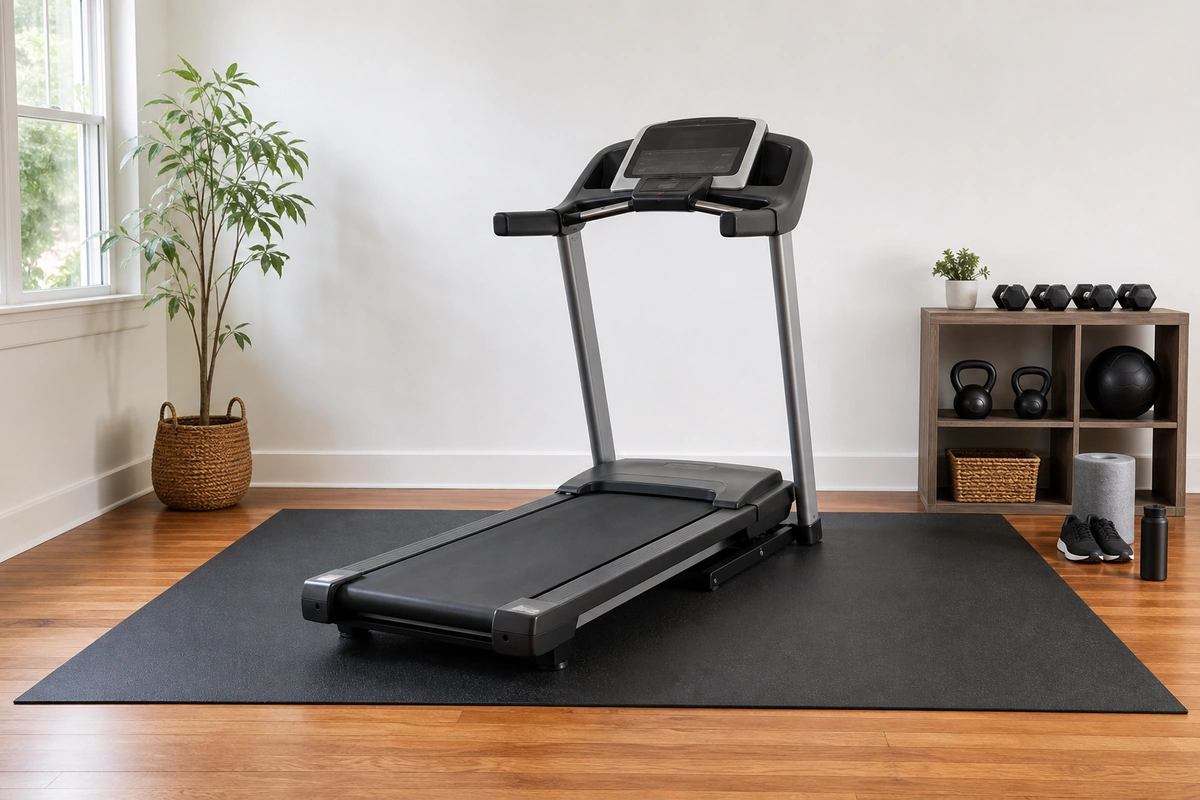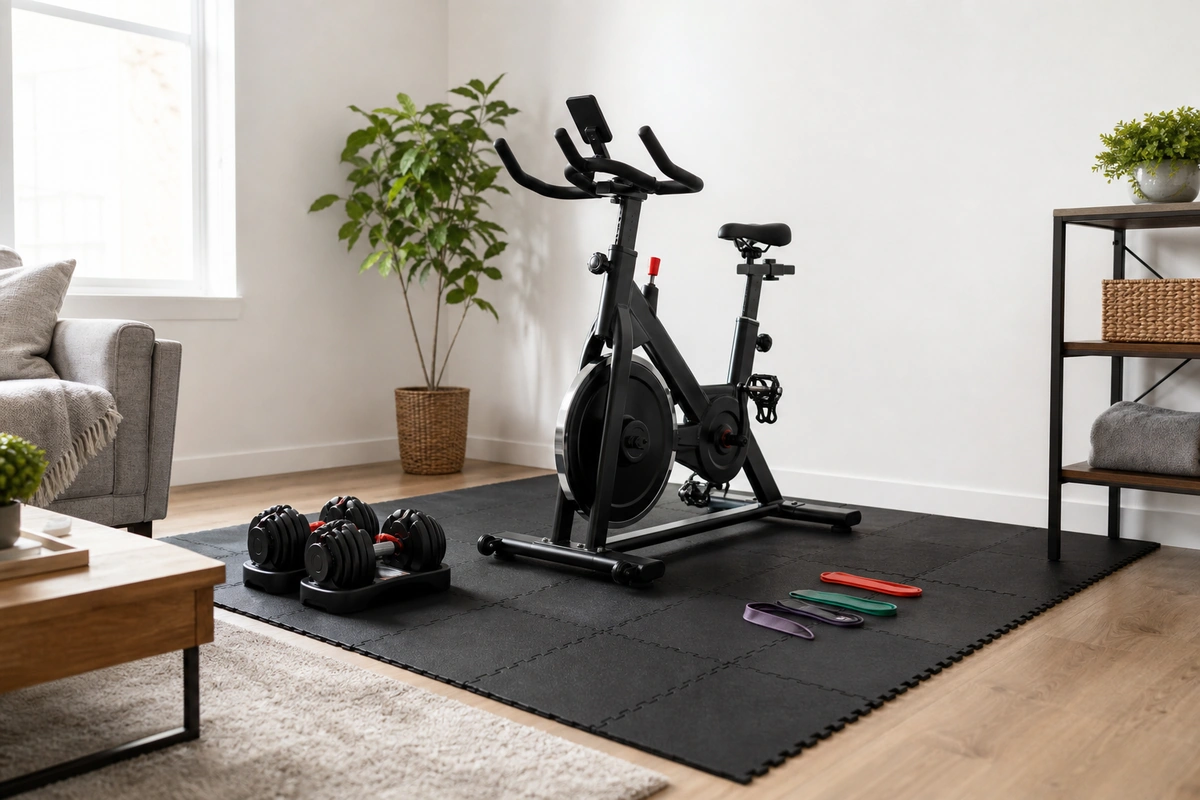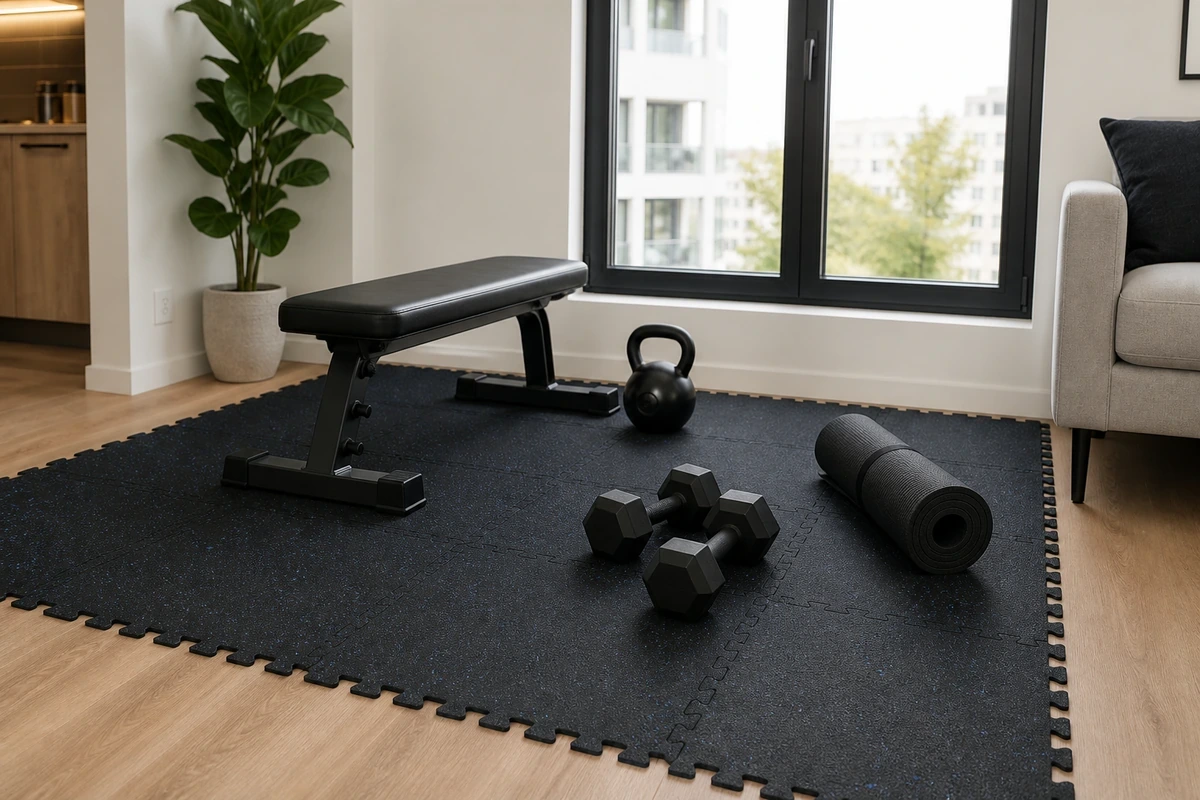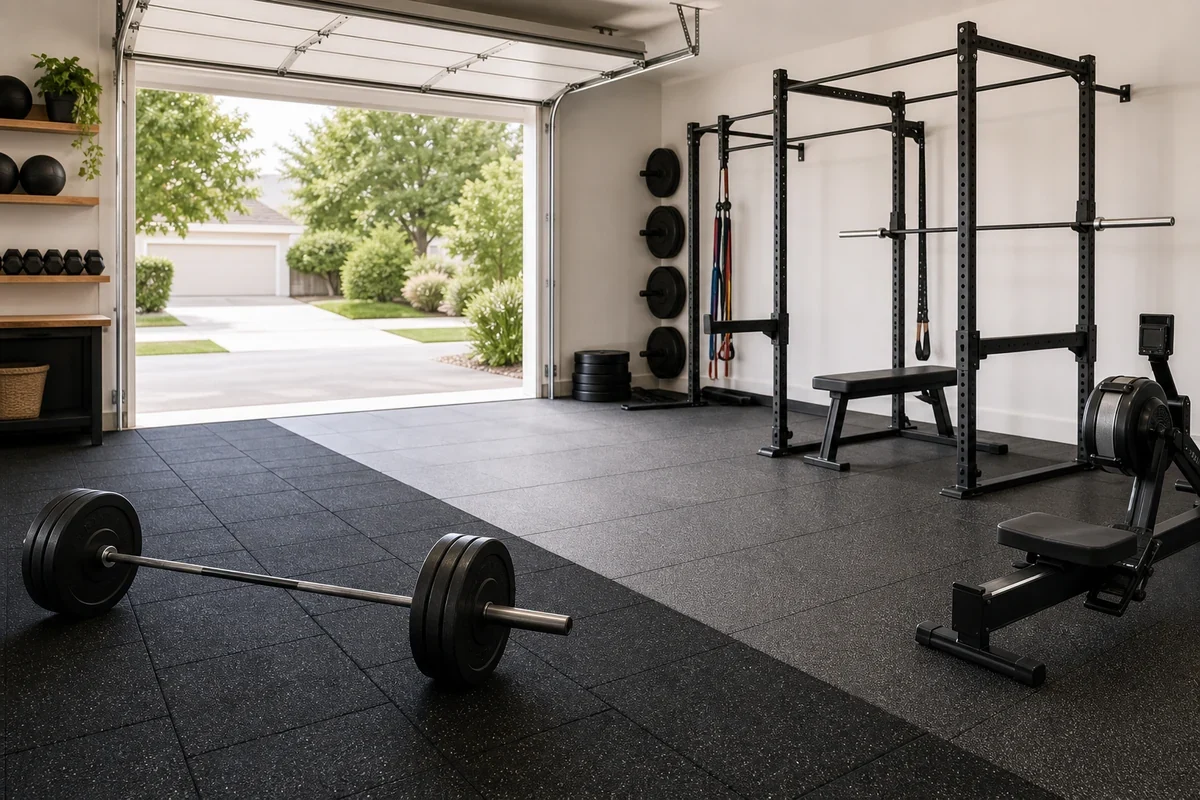
You finished the WOD. Your sled scraped a tile. Your bumper bounced sideways off thin rubber. Your rig footing creaked.
That’s the reality of running CrossFit on flooring designed for a generic gym.
By the end of this guide, you’ll know which CrossFit gym flooring goes in which zone — and which products fit your budget without compromising the lift, the sled, or the wall ball.
We’ll cover what makes CrossFit different, the four-zone framework, the material matrix per zone, garage and affiliate setups, rig mounting realities, and a real cost breakdown.
Let’s break it down.
Quick Answer: CrossFit floors should be zoned, not one-size-fits-all — use 8mm-plus rubber tiles or rolls in the lifting and drop zone, firmer thinner rubber under the rig and cardio, and tough matting in the sled lane. Rubber (SBR/EPDM) wins almost everywhere because it absorbs barbell and wall-ball impact and protects the slab; keep foam to stretching corners only. Mount rigs through the flooring into the slab, not on top of the mats.
Why CrossFit flooring is different
A general gym has one activity per square foot. CrossFit has four — sometimes in the same minute.
Bumper plate drops produce vertical impact: 200–500 lbs of instantaneous force on a 3-inch contact patch. Plyometrics add repeat impact (and the occasional missed-landing). Sled push generates horizontal shear that scrapes the top surface. Rower row and mobility work create high foot-traffic zones with no real impact at all.
Here’s the deal: pick one floor type for the whole space and you’ll fail one of those four every workout. Mix the wrong materials and you’ll be replacing tiles every 18 months.
That’s why every well-designed CrossFit gym — garage or commercial affiliate — uses 2 to 3 distinct flooring specs in different zones, not one universal mat.
If your gym has shifted tiles, dented surfaces, or wear patterns telegraphing through to the slab, you’re already paying that tax. The fix is zoning, not thicker tiles everywhere.
There’s also an operational angle most articles skip. A box that has to re-seat tiles every weekend loses staff time. A garage gym where the sled scrapes the same seam for six months chews through replacement tiles faster than the rest of the floor combined. Zoning isn’t optional rigor — it’s the lowest-friction way to keep the gym running.
The 4 zones every CrossFit gym needs
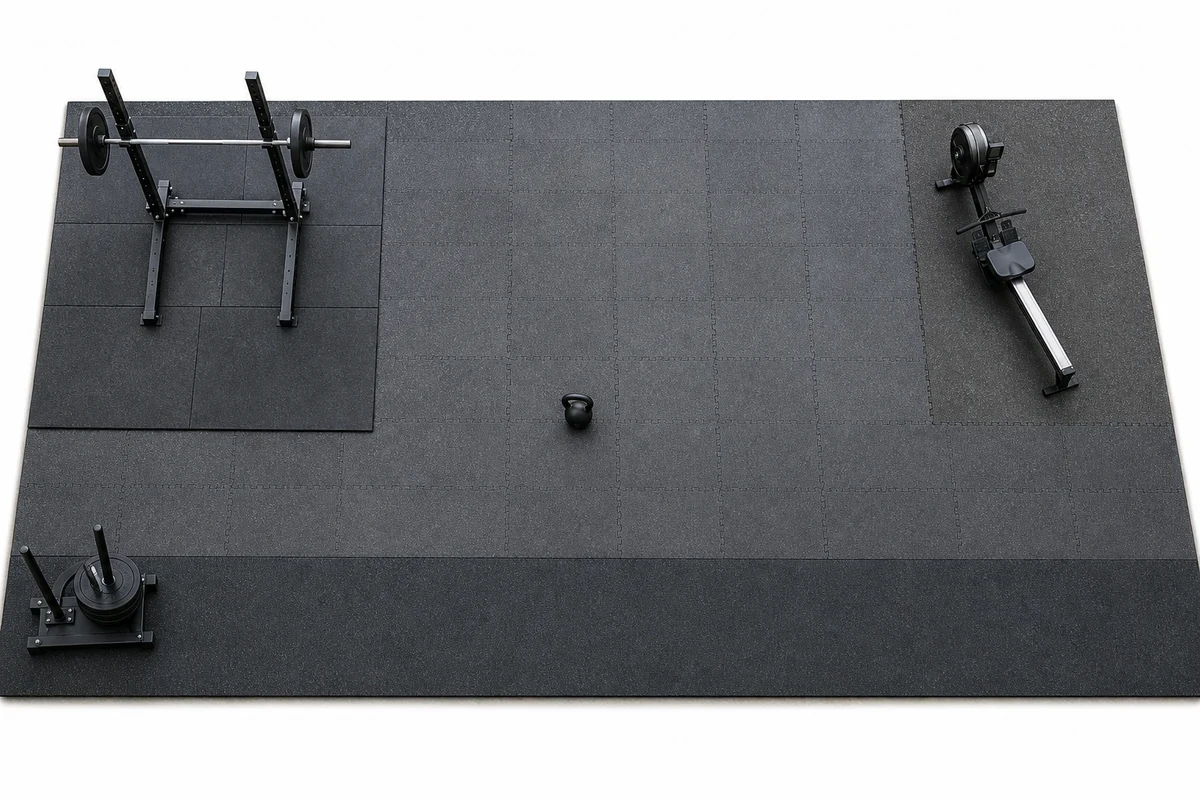
Before you buy a single tile, map the floor by activity. These four zones cover ~95% of CrossFit programming.
Drop zone (~6×8 ft per platform)
Where bumper plates hit. Where deadlifts, cleans, and snatches finish.
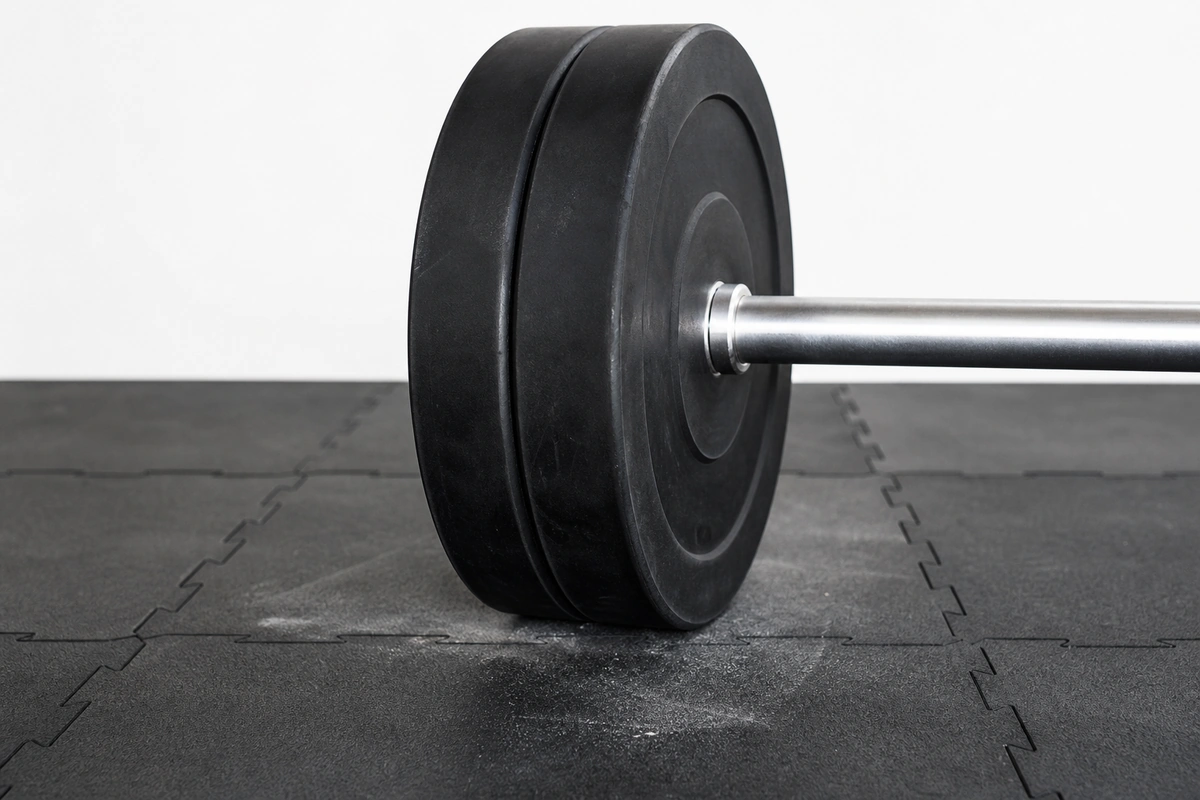
Spec: 0.70″ rubber interlocking tiles OR horse stall mats (¾” thick) over a plywood layer. Anything thinner and the tiles crack at the seams over time, the plates bounce sideways, and your downstairs neighbor — or members one room over — feel the impact.
What goes wrong with thinner: tile interlocks fatigue, hairline cracks form within 12 months of regular drops, and bumper plates start landing inconsistently. Replace once or replace twice — your call.
Training / general zone (most of the floor)
Where bodyweight, dumbbells, kettlebells, lateral work, and warmups happen.
Spec: 0.47″ high-density interlocking tiles (Norsk Rubber-Tec foam co-polymer or rubber equivalents). Thick enough to absorb dumbbell set-downs and kettlebell drops; thin enough to give honest footing for lateral work and lunges.
This zone covers ~70% of the gym’s square footage. Spending more on 0.70″ here is overkill — you’re paying for impact protection you don’t need.
Sled track (3 ft × length-of-room)
Where sleds, prowlers, and farmer’s-walk lengths run.
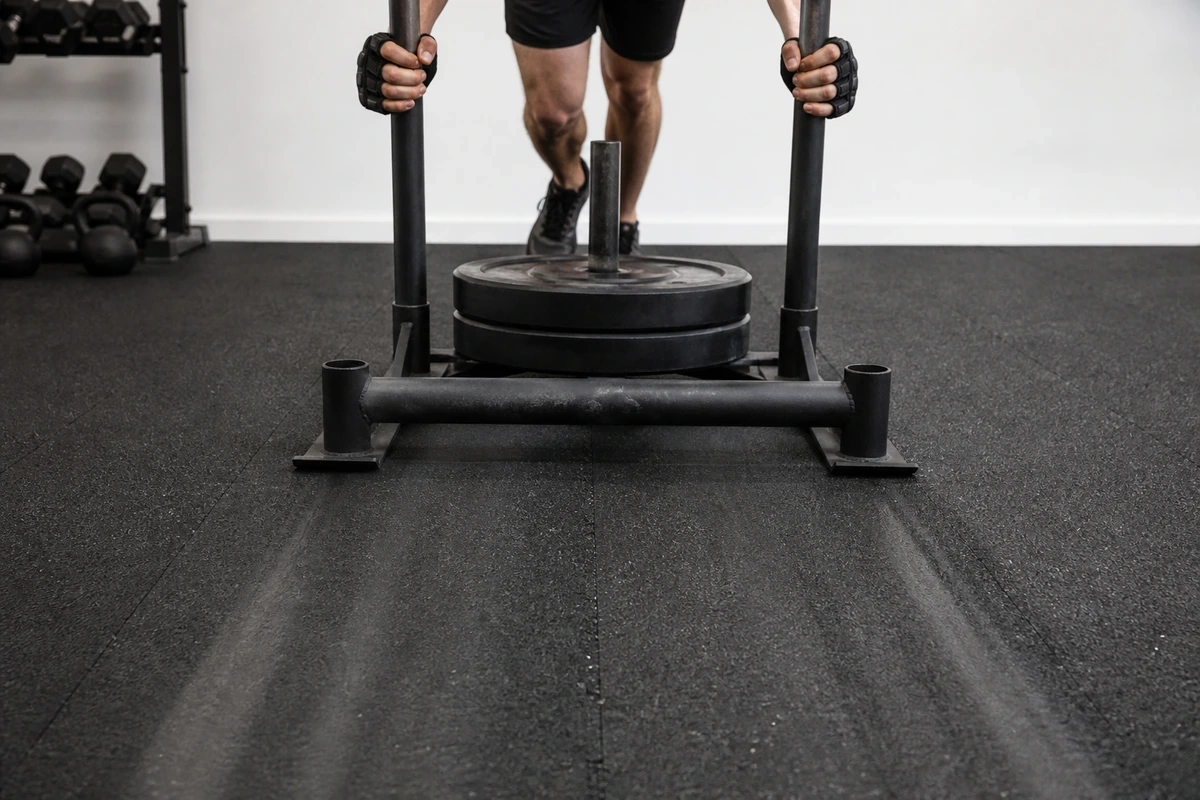
Now: sled push is a horizontal-shear test on the top surface. Tile interlocks separate under sustained shear; thin rubber ablates under repeated runs.
Spec: 0.70″ locked-edge tiles OR (better) rubber rolls glued down. If your sled track is short enough that tiles work, use the densest, locked-edge variant. If your space allows a glued rubber roll, that’s the long-term winner — no seam separation, ever.
Mobility / rower zone (~6×6 ft)
Where stretching, foam rolling, ab work, and rower rows happen.
Spec: 0.47″ rubber OR a foam-mat layer stacked on top of rubber for ground-pose comfort. No impact protection needed; what matters is comfort under bare hands and knees.
Here’s the catch: don’t put your foam mat layer on top of 0.70″ tiles. The combined height under bare feet feels unstable and you’ll twist an ankle the first time you step from foam onto tile.
Material matrix: pick per zone
This table is the buying decision. Find your activity, see which materials work.
| Activity | Rubber 0.47″ Interlock | Rubber 0.70″ Interlock | Horse Stall Mats | PVC (Rhino-Tec) | Foam |
|---|---|---|---|---|---|
| Drops (bumper plates) | CautionMarginal for heavy drops | Yes | YesBest value | NoCracks under drops | No |
| Plyo (box jumps, broad jumps) | Yes | Yes | Yes | CautionSlick when sweaty | Caution |
| Sled push | CautionTile movement | YesIf edges locked | Yes | Yes | No |
| Wall ball | Yes | Yes | Yes | Caution | Yes |
| Bodyweight / general | Yes | Overkill | CautionHeavy / dense | Yes | Yes |
| Mobility / rower | Yes | Overkill | Yes | Yes | Yes |
Most CrossFit gyms run a hybrid: 0.47″ rubber across the room with 0.70″ tiles or horse stall mats stacked in the drop zones. That single decision absorbs ~80% of the wear without buying premium tile for the entire floor.
Want to know the best part? Horse stall mats are the under-discussed budget king for drop zones. They’re $50–$70 each (4×6 ft, ¾” thick), absurdly heavy, and built to take far more abuse than any home-gym setup will ever inflict. Their downside is purely cosmetic: they smell for the first month and look industrial.
For the platform-specific build (raised, wood-bordered, sound-isolated), see our weightlifting flooring guide — that article handles the deeper platform-construction math.
One more horse-stall caveat: weight matters. Each ¾” stall mat is 80–110 lbs. Two-person carry from the truck is the realistic minimum. Plan accordingly if you live in a third-floor walkup considering CrossFit at home — at that point, premium tiles or modified programming (no drops) is the path.
Garage CrossFit setup (2-car blueprint)
A 24×24 ft 2-car garage is the most common starting point. Here’s how to zone it.
Drop zone: 8×8 ft corner, horse stall mats (¾”) or solid-rubber tiles over a ¾” plywood backer. This is where deadlifts, cleans, and snatches finish.
General training zone: 16×16 ft, 0.47″ Rubber-Tec interlocking tiles (high-density foam co-polymer). Covers bodyweight work, dumbbell sessions, kettlebell flows, and warmups.
Sled track: 4×24 ft along one wall, glued rubber roll. If you can’t accept glue (rental, future flexibility), use 0.70″ locked-edge tiles. Shorter track? Skip the dedicated sled lane and push along the general training zone — just expect faster wear.
Rower zone: the remaining 4×8 ft area. Standard 0.47″ rubber works fine here.
Concrete prep is non-negotiable for garage CrossFit. The slab moves, vapors, and cracks like every other concrete substrate. For the universal pre-install checklist — moisture testing, crack repair, leveling specs — see our installing flooring over concrete guide.
Budget for a full garage CrossFit setup: $400–$1,500 depending on how much horse stall mat you use and whether you glue the sled track.
Commercial CrossFit (box / affiliate) setup
A commercial box runs 2,000–6,000 sq ft and serves 50–200 active members. Zoning gets more complex at scale.
Drop zones: typically 3 to 5 platforms, not one. Each platform is its own 6×8 zone with 0.70″ rubber or horse stall mats. Spread across the floor so multiple members can lift simultaneously without crowding.
Sled track: longer (40+ ft), almost always glued rubber rolls. Tile-shifting at this scale is operationally untenable — staff doesn’t have time to re-seat tiles after every WOD.
Acoustic considerations: most boxes are in industrial or strip-mall spaces with shared walls. Drop-zone subfloor isolation matters; some affiliates add a secondary rubber underlayment beneath the platform tiles.
Insurance and liability: ASTM F1292 impact-attenuation specs apply to plyo zones in some jurisdictions. Check with your insurer before final tile selection.
B2B buying notes: order samples first, request bulk pricing on Rubber-Tec or Rhino-Tec, and confirm lead times — a box opening with the wrong floor on day one is operationally crippling.
Lease considerations matter too. Glued rubber rolls disqualify most commercial leases that require turn-key restoration; if your landlord prohibits floor adhesives, switch to locked-edge tiles or accept the security-deposit risk. Many established affiliates negotiate this upfront — a few don’t, and discover the constraint at lease-end.
Rig mounting on rubber: what actually works
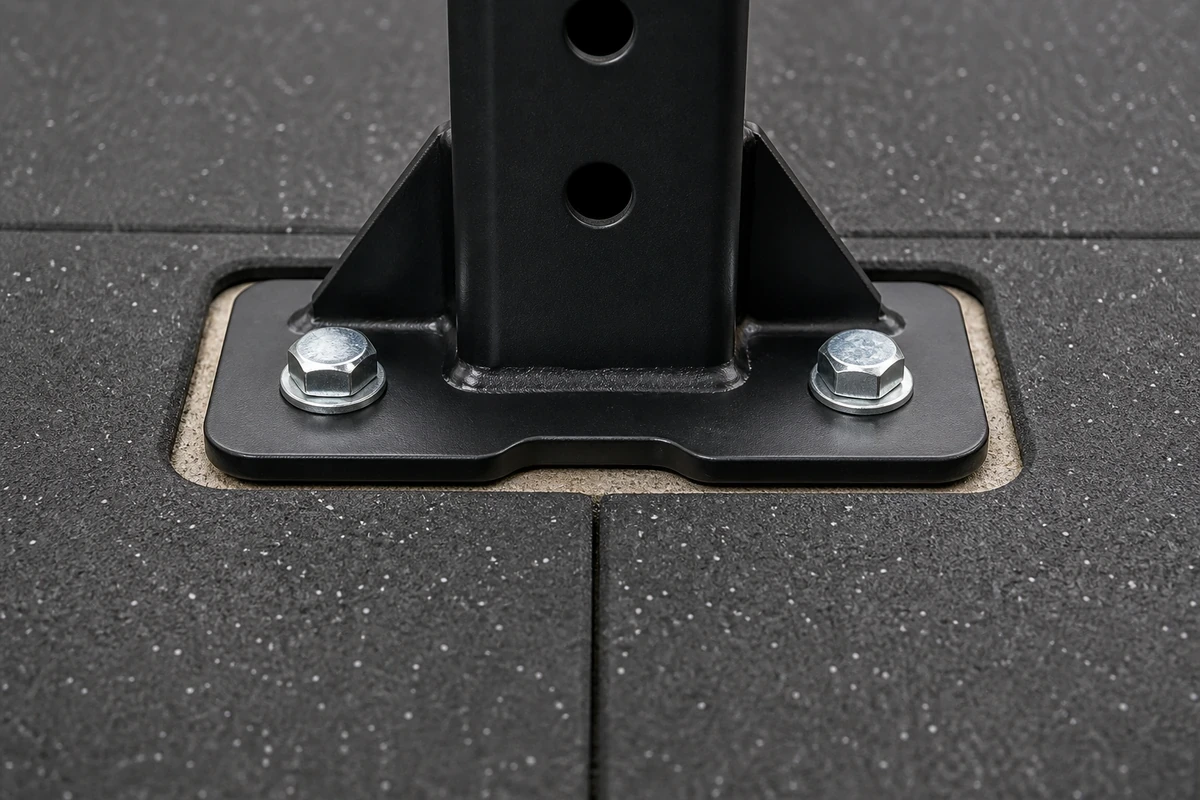
Common myth: “You must mount rigs directly on bare concrete.”
Reality: rigs with floor-mount footplates can mount through rubber tiles into concrete with zero performance compromise. The technique is simple — cut tile to the footplate’s outline, anchor the rig as normal, and leave a ¼” clearance around the bolt for thermal/movement tolerance.
The genuine constraint is rubber thickness compressing under the rig’s loaded weight. Use 0.47″ tile minimum beneath the rig footprint, and prefer 0.70″ if drops happen near the rig (which they almost always do in CrossFit).
Free-standing rigs with weighted bases need no concrete anchoring — but don’t drop bumpers on the rubber inside the rig footprint. Concentrated drops + a rig pressing down on the same tile = premature tile fatigue at the worst possible point.
Real cost breakdown
Floor cost scales with both square footage and zone mix. Here’s what actual CrossFit setups run in 2026.
| Setup | Sq Ft | Floor Mix | Materials | Cost / sq ft |
|---|---|---|---|---|
| Garage (budget) | 400 | Horse stall mats + 0.47″ rubber elsewhere | $300–$500 | $0.75–$1.25 |
| Garage (mid) | 400 | 0.47″ Rubber-Tec + stall-mat drop zone | $1,000–$1,600 | $2.50–$4 |
| Garage (premium) | 400 | 0.70″ Rubber-Tec + stall-mat drop zones + glued sled track | $2,000–$3,200 | $5–$8 |
| Commercial Box (budget) | 3,000 | Rubber rolls glued + 0.70″ drop zones | $9K–$18K | $3–$6 |
| Commercial Box (premium) | 3,000 | Glued + tiled hybrid + ASTM-rated plyo | $18K–$30K | $6–$10 |
The honest take: at any scale, “premium tile everywhere” is rarely worth it. The garage-budget setup with horse stall mats in the drop zone outperforms a $3,000 all-premium-tile setup for actual CrossFit programming — because the drop zone is where the wear happens.
Glued rubber rolls win at commercial scale not because they’re cheaper but because they don’t shift. Operationally, that’s worth the install effort.
The cost-per-WOD math also matters. A garage CrossFit setup at $1,500 amortized over five years of daily training works out to under a dollar per workout. A premium $3,200 setup buys you maybe 18 months of additional life on the same wear surfaces — barely a rounding error. Spend where the wear actually concentrates (drop zone), not on cosmetic uniformity across the room.
Bottom line
CrossFit needs zoned flooring, not one mat for the whole space.
Drop zone gets 0.70″ rubber or horse stall mats. General zone gets 0.47″ rubber. Sled track gets locked-edge tiles or glued rolls. Mobility zone gets whatever’s comfortable.
Match the floor to the activity per zone, not the average — that’s how good CrossFit gyms get built. For pillar-level material comparison, see our garage flooring options guide. For platform-specific construction, see our weightlifting flooring guide.
Frequently asked questions
What is the best flooring for CrossFit?
There’s no single best floor — CrossFit needs zones. Drop zones use 0.70″ rubber tiles or horse stall mats. General training zones use 0.47″ rubber tiles. Sled tracks use locked-edge tiles or glued rubber rolls. Mobility zones use thinner rubber or foam. Match the floor to the activity, not the average.
How thick should CrossFit flooring be?
For drop zones where bumper plates hit, 0.70″ minimum (or horse stall mats at ¾”). For general training where bodyweight, dumbbells, and kettlebells happen, 0.47″ is the sweet spot. Going thicker everywhere is wasted spend; going thinner in drop zones means cracked tiles within 12 months.
Can I do CrossFit on PVC tiles?
For non-drop activities — bodyweight, dumbbells, sleds, rower — yes, PVC interlocking tiles like Rhino-Tec work fine. But never drop bumper plates on PVC; the plates crack the tile within a few sessions. PVC is a budget pick for general zones, not a substitute for rubber in drop zones.
Can you drop weights on horse stall mats?
Yes — horse stall mats are the budget king for CrossFit drop zones. Their ¾” rubber thickness handles bumper drops better than most premium gym tiles, and they’re cheap (~$50–$70 each, 4×6 ft). Downsides: they smell for the first month and look industrial. Layer them over plywood for the best dampening.
What’s the difference between CrossFit and weightlifting flooring?
Weightlifting flooring optimizes for one activity: bumper plate drops on a competition platform. CrossFit flooring needs to handle drops PLUS plyometrics, sled push, rower row, and mobility work — typically across 4 zones in the same room. Weightlifting tends toward one premium setup; CrossFit tends toward zoned hybrids.
Can I install CrossFit flooring over concrete in my garage?
Yes — most garage CrossFit gyms install directly over a properly prepped concrete slab. Test for moisture, repair cracks per width, and level any deviation over ¼” per 10 feet. For the full prep checklist, see our installing flooring over concrete guide — the universal substrate prep work applies to every CrossFit floor type.
Ready to build your CrossFit gym floor?
Norsk-Stor’s Rubber-Tec line is the workhorse for CrossFit general training zones — the 0.70″ high-density foam co-polymer tiles cushion dumbbell and kettlebell work, and the 0.47″ line covers conditioning space cleanly. For barbell drop zones, use horse stall mats or solid-rubber tiles over plywood. For budget builds, the Rhino-Tec PVC line covers non-drop zones at lower cost.
Browse the full gym flooring collection and zone your space to match how CrossFit actually trains.