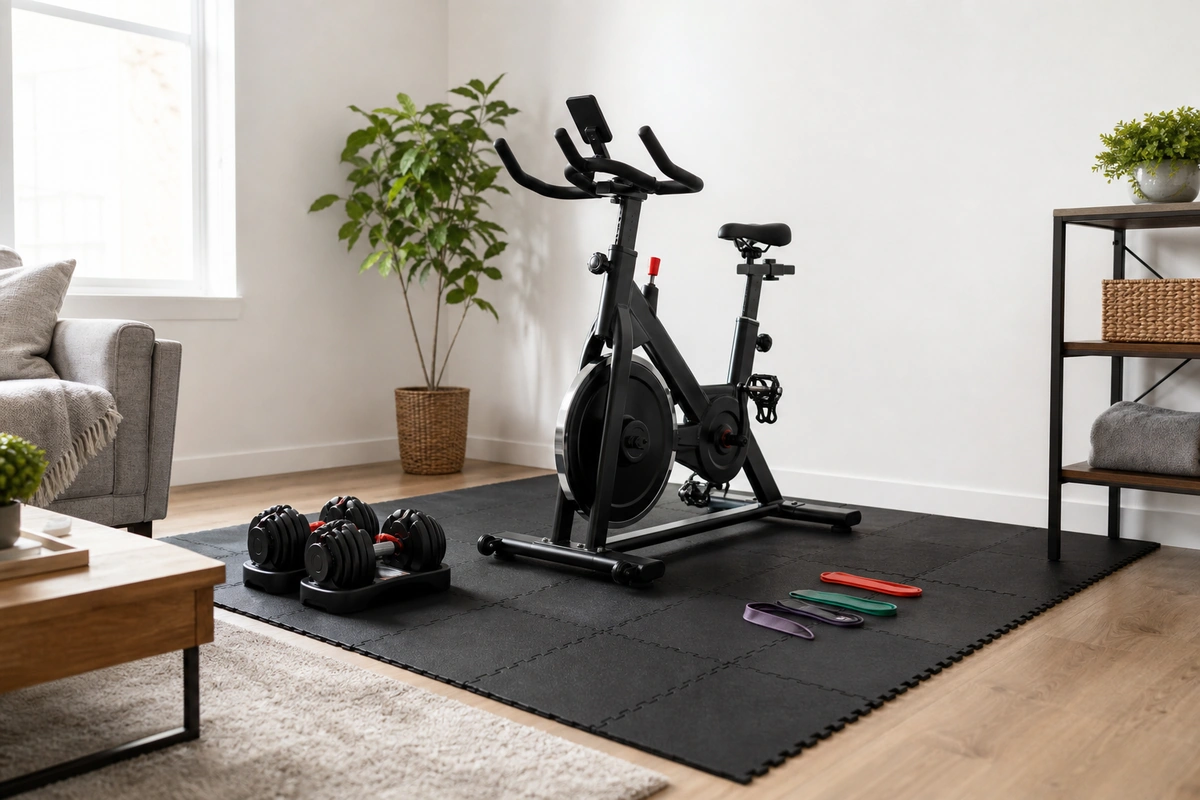
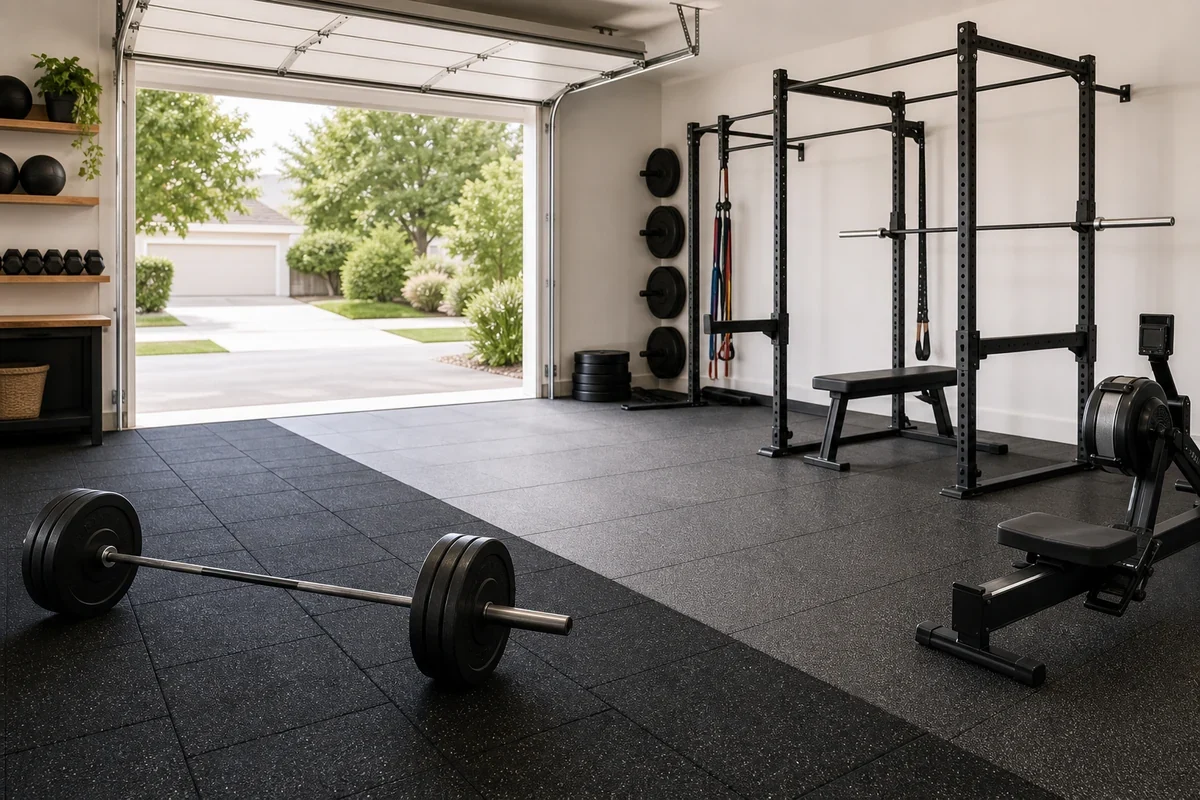
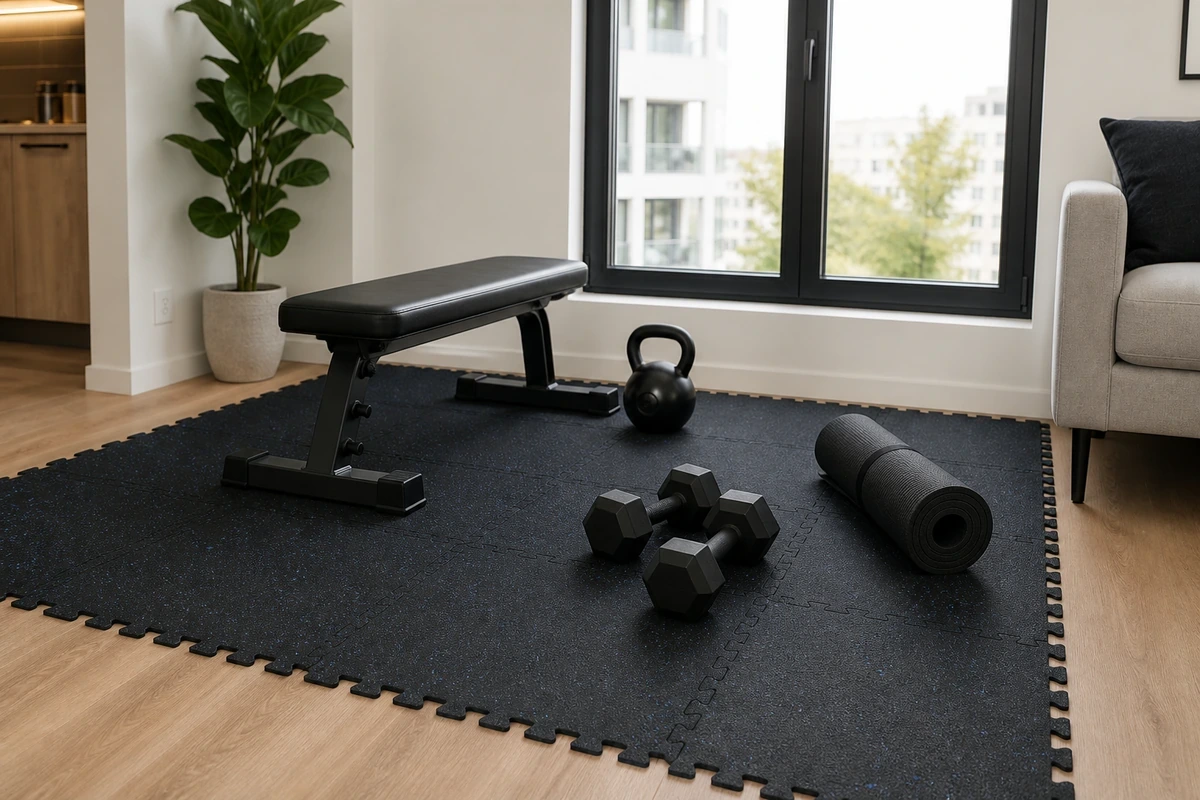
A treadmill is 250–350 lbs of machine hammering the same spot on your floor for 30+ minutes a day. On hardwood, laminate, or tile, that shows up as dents, scratches, and transferred vibration that everyone in the house hears. The right treadmill mat stops all three problems at once — for $40–$150, depending on floor type.
This guide covers treadmill mats that actually work: the thickness that dampens vibration, the size that protects the full footprint (including where you step off), and the install approach that keeps the mat from sliding on hardwood. You’ll also see why the cheap PVC mats in big-box stores fail after 90 days, and when it’s worth paying for commercial-grade rubber.
Whether your treadmill sits on hardwood, laminate, tile, or carpet, there’s a right mat for each surface — and a wrong one that makes things worse. Here’s the difference.
Why You Need a Treadmill Mat
Three problems, one solution.
1. Floor damage. A loaded treadmill concentrates 250–350 lbs on six small rubber feet. On hardwood, that compresses the wood fibers under each foot over time. On laminate, it cracks the click-lock seams. On tile, it can hairline-crack the grout. A mat spreads the load across the full machine footprint.
2. Vibration noise. Motor vibration + belt impact travels through the floor into the building’s structure. On a ground floor over concrete slab, it’s quiet. On a second floor over joists, it’s obvious. On a third-floor apartment over a downstairs unit, it’s a neighbor complaint waiting to happen. A dense rubber mat absorbs 60–70% of impact vibration before it reaches the subfloor.
3. Sweat + debris. Treadmills drip sweat, shed belt lubricant, and track dirt from your shoes. On hardwood, that moisture seeps into the finish and damages it over 6–12 months. A mat catches all of it and wipes clean.
Quick Answer: Best Treadmill Mats by Floor Type
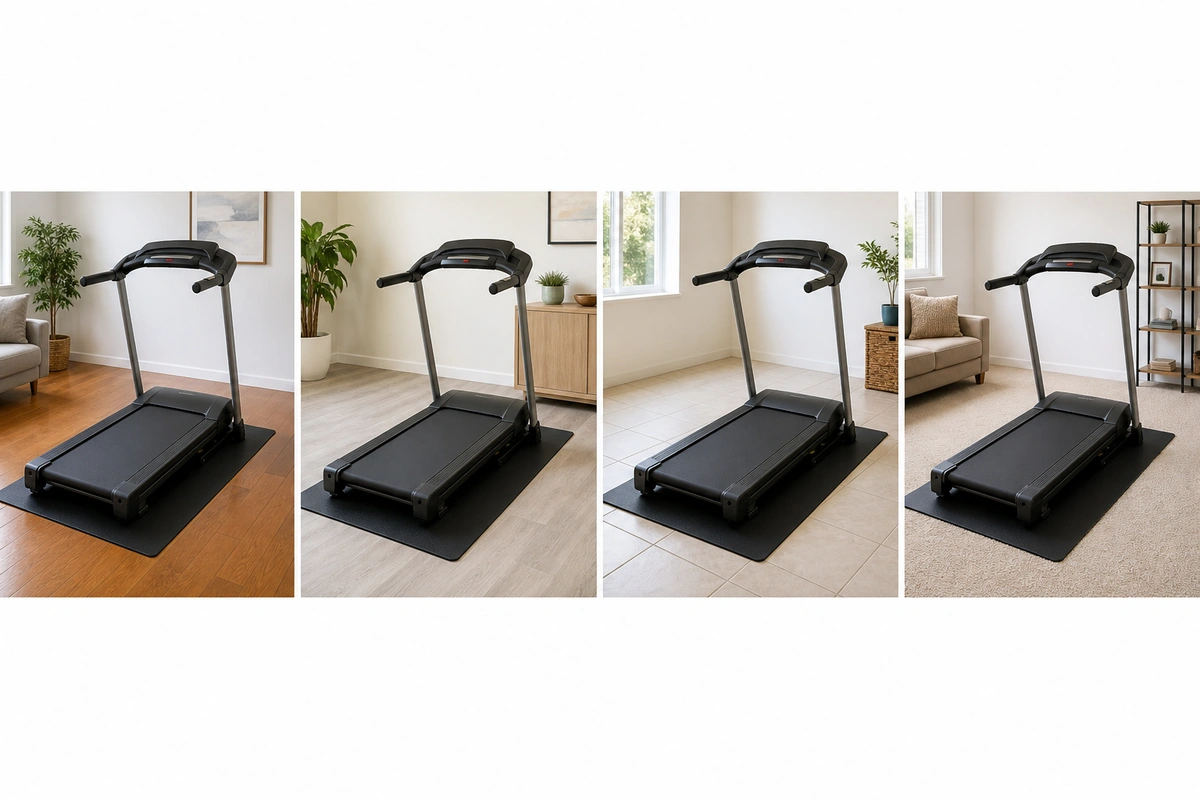
| Floor type | Recommended mat | Why | Thickness |
|---|---|---|---|
| Hardwood | Commercial-grade rubber mat, 3’×6.5′ | Won’t transfer color, resists sliding, absorbs vibration | 1/2″ |
| Laminate | PVC/rubber hybrid mat, 3’×6.5′ | Protects click-lock seams from load concentration | 3/8″ |
| Tile | High-density rubber mat, 3’×6.5′ | Stops hairline cracking in grout from repeated impact | 1/2″ |
| Carpet (low pile) | Rubber mat on plywood underlayment | Prevents mat from sinking into pile unevenly | 1/2″ + 3/8″ plywood |
| Carpet (plush) | Not recommended without hard underlayment | Compression is uneven; use plywood first | N/A |
| Concrete (garage / basement) | Any 3/8″+ rubber or PVC mat | Floor protection less critical; focus on noise | 3/8″ |
Sizing: How Big Should the Mat Be?
The mat must extend 6–12 inches past the treadmill footprint on all sides. Here’s why.
When you step on or off the treadmill, you often land beside it, not on it. If the mat ends exactly at the treadmill edge, your foot hits bare floor (or bare carpet), which:
- Damages the floor right at the mat seam
- Makes the mat shift over time as you step off
- Looks like a mistake
Standard treadmill base dimensions:
- Compact folding treadmills: ~70″ L × 32″ W
- Full-size residential treadmills: ~78–84″ L × 36″ W
- Commercial-grade treadmills: 85″+ L × 40″+ W
Recommended mat size for residential treadmills: 3′ × 6.5′ (36″ × 78″) minimum; 4′ × 7′ (48″ × 84″) ideal. The extra width gives you a clean step-on/step-off platform.
If your treadmill is compact, a 3′ × 6′ mat is enough. Don’t go smaller than that — you lose the step-off buffer.
Thickness: Why 1/2″ Is the Sweet Spot
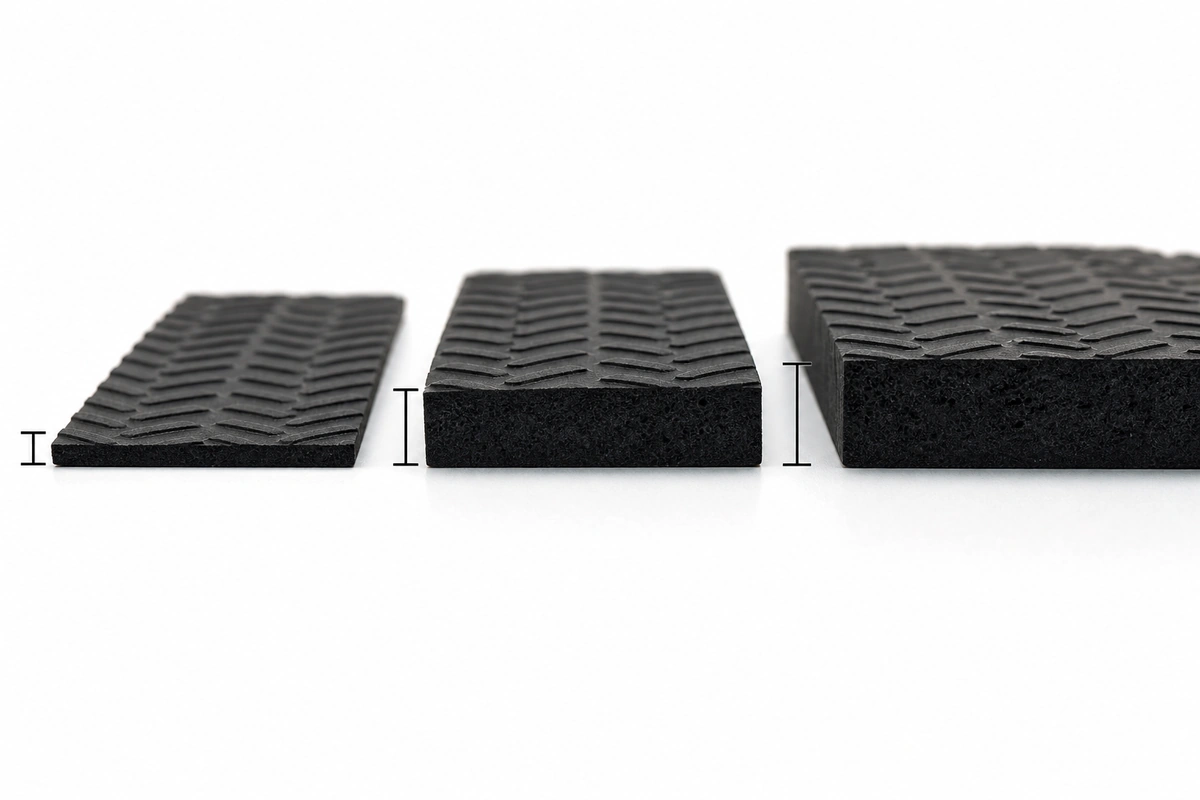
Treadmill mats come in three common thickness ranges:
1/4″ (6mm) — Cheap, found in big-box stores for $25–40. Protects against scratches but does almost nothing for vibration or noise. OK for ground-floor concrete slabs where noise isn’t a concern. Wrong choice for hardwood or upper floors.
3/8″ (10mm) — Mid-range, $50–80. Good compromise. Handles light residential treadmills (under 300 lbs) on most surfaces. Typical “good” big-box option.
1/2″ (12mm) — Commercial-grade, $90–150. Handles heavy treadmills (350+ lbs), maximum vibration dampening, best for hardwood and upper floors. The right choice for anyone who lifts the treadmill onto and off of a finished floor regularly.
3/4″ (19mm) — Overbuilt. Only worth the cost if you have a commercial-grade treadmill on hardwood over a finished ceiling, or in an apartment where noise control is paramount.
Rule: on any floor that costs more than the treadmill, upgrade to 1/2″. The math pays for itself the first time you avoid a floor refinish.
Material: Rubber vs PVC vs Foam
Rubber (recycled crumb rubber, EPDM, or natural) — The best overall. Dense, heavy, stays put. Absorbs vibration well. Most commercial treadmill mats are recycled rubber. Potential downside: some rubber mats smell strongly for 1–2 weeks and can transfer black residue onto very light floors if not washed first.
PVC (vinyl) — Middle of the road. Lighter than rubber, easier to clean, no smell. Doesn’t absorb vibration as well as rubber. Good for laminate floors and situations where you’ll reposition the mat often.
Foam (EVA / high-density polyethylene) — Least expensive. Cushy underfoot, but compresses under treadmill weight over 6–12 months, creating permanent dents that eventually transfer to the floor below. Avoid foam for anything heavier than a folding under-desk treadmill.
Treadmill Mat on Hardwood Floors
Hardwood is the trickiest surface. You want full vibration protection plus zero color transfer and zero scratching.
Install steps:
- Clean the floor first. Any grit trapped under the mat will grind into the finish every time the treadmill shifts.
- Lay a thin barrier layer if the mat is aggressive rubber. Some recycled rubber mats bleed black rubber residue onto light oak or maple over months. A layer of felt or rosin paper between hardwood and mat prevents this. Commercial-grade EPDM rubber mats don’t have this issue.
- Use a 1/2″ rubber mat, 3’×6.5′ minimum.
- Don’t use double-sided tape or adhesive under the mat on hardwood. It will pull up the finish when you remove the mat later.
- Rotate the mat 180° every 6 months to distribute wear evenly on both the mat and the floor.
Treadmill Mat on Laminate + Engineered Hardwood
Same approach as hardwood, with one adjustment: laminate’s click-lock seams are the weak point, not the surface. The mat spreads load across seams instead of concentrating it on the feet over a single row of planks.
For laminate:
- 3/8″ mat is fine (load-spreading matters more than absorption here)
- Confirm the mat is at least 6″ wider than the treadmill base on each side
- Check the mat for wide backing channels — these can trap moisture against laminate and cause edge swelling
Treadmill Mat on Carpet
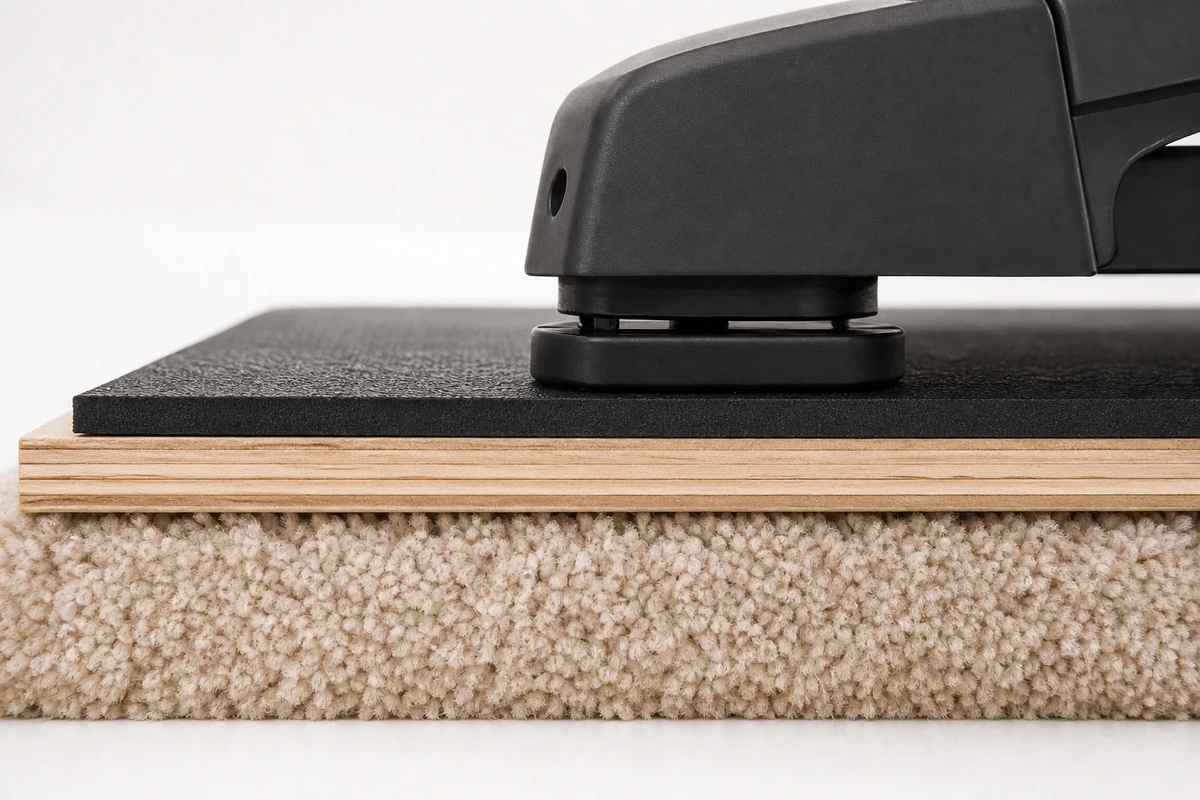
Carpet changes the problem. You don’t need to protect the carpet from scratches — you need to stop the treadmill from sinking unevenly into the pile and rocking during use.
Low-pile carpet (commercial-style, under 1/4″):
- A standard rubber mat works. The carpet slightly compresses under the mat but stays stable.
- 3/8″ rubber is fine.
Plush carpet (residential 1/2″+ pile) or memory-foam padding:
- A rubber mat alone will sink unevenly under treadmill feet, creating a rocking platform that’s unsafe.
- Install a rigid underlayment first: 1/2″ plywood or OSB sheet, cut slightly larger than the mat. This gives the mat a stable base.
- Then the rubber mat goes on top of the plywood.
- Yes, it’s more work. No, you can’t skip it without the treadmill eventually tipping.
Treadmill Mat on Tile
Tile handles weight well but is brittle in narrow ways: impact from the treadmill’s rhythmic loading can hairline-crack grout lines or, in extreme cases, chip tiles under the feet.
- Use a 1/2″ high-density rubber mat (not foam)
- Make sure the mat extends past the treadmill footprint by at least 12″ on the long ends (your step-off zone)
- Don’t install the treadmill directly over a floor drain or heating register — the mat will trap air underneath and create pressure points
Noise Reduction: What to Expect
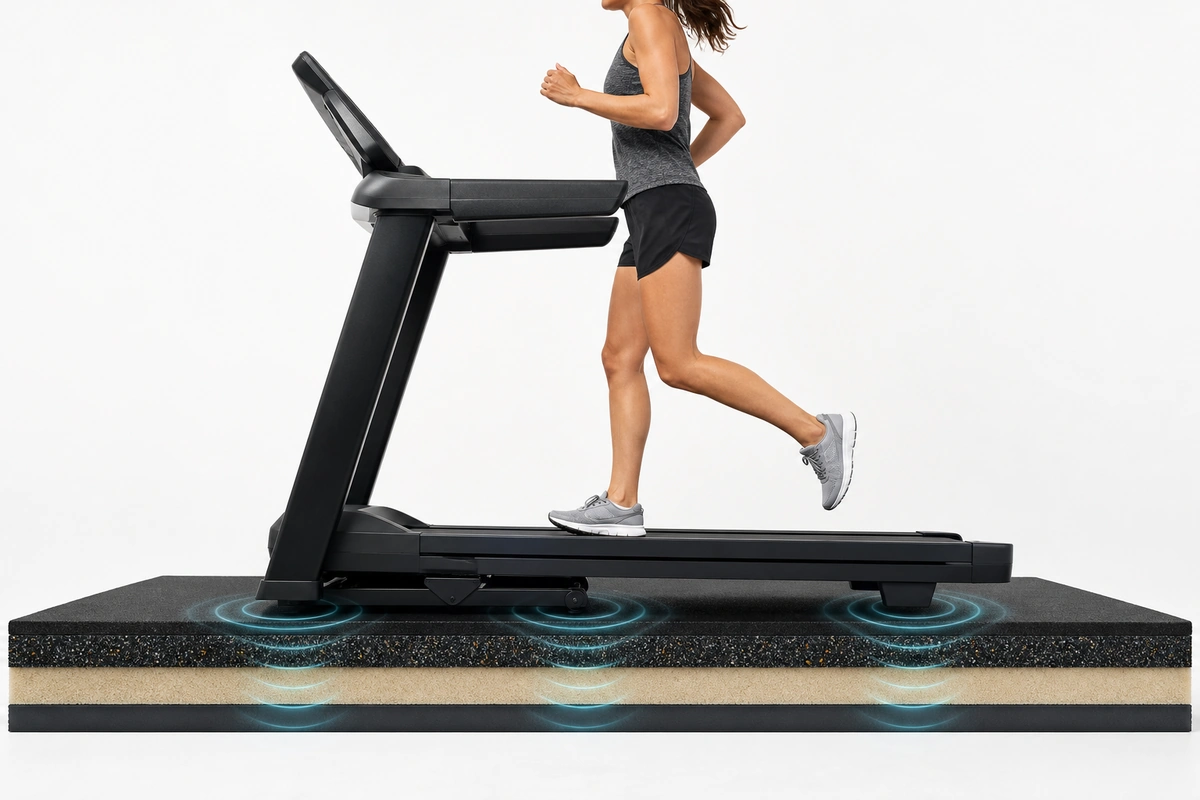
Realistic numbers from vibration testing:
| Setup | Impact noise reduction | Who notices |
|---|---|---|
| Bare hardwood / laminate | 0% baseline | Everyone downstairs |
| 1/4″ PVC mat | ~30% | Downstairs still notices |
| 3/8″ rubber mat | ~50% | Muffled but audible |
| 1/2″ rubber mat | ~65% | Quiet thud, not a hammer |
| 1/2″ rubber + anti-vibration feet | ~75% | Almost inaudible downstairs |
If you live above someone, invest in anti-vibration feet (~$25) in addition to the mat. The feet attack vibration at the source (motor frame); the mat attacks what escapes to the floor. Combined, they’re substantially quieter than either alone.
Treadmills are just one piece of the apartment cardio puzzle. For the full quiet-cardio playbook — rowers, bikes, jump-substitutes, and lift modifications that won’t damage hardwood — read our apartment workout equipment guide.
What About “Running on Concrete” (Garage / Basement)?
Concrete doesn’t need protection — it’s harder than the treadmill. The only reason to use a mat on concrete is comfort (cushioning under your feet) and noise (if the basement is below living space).
- 3/8″ rubber is plenty
- Skip foam (compresses; dents transfer)
- Skip PVC (slides on polished concrete)
If the garage or basement is unheated, confirm the mat is rated for freezing temperatures. Most rubber mats handle -20°F fine; most foam and low-grade PVC get stiff and crack.
Care + Maintenance
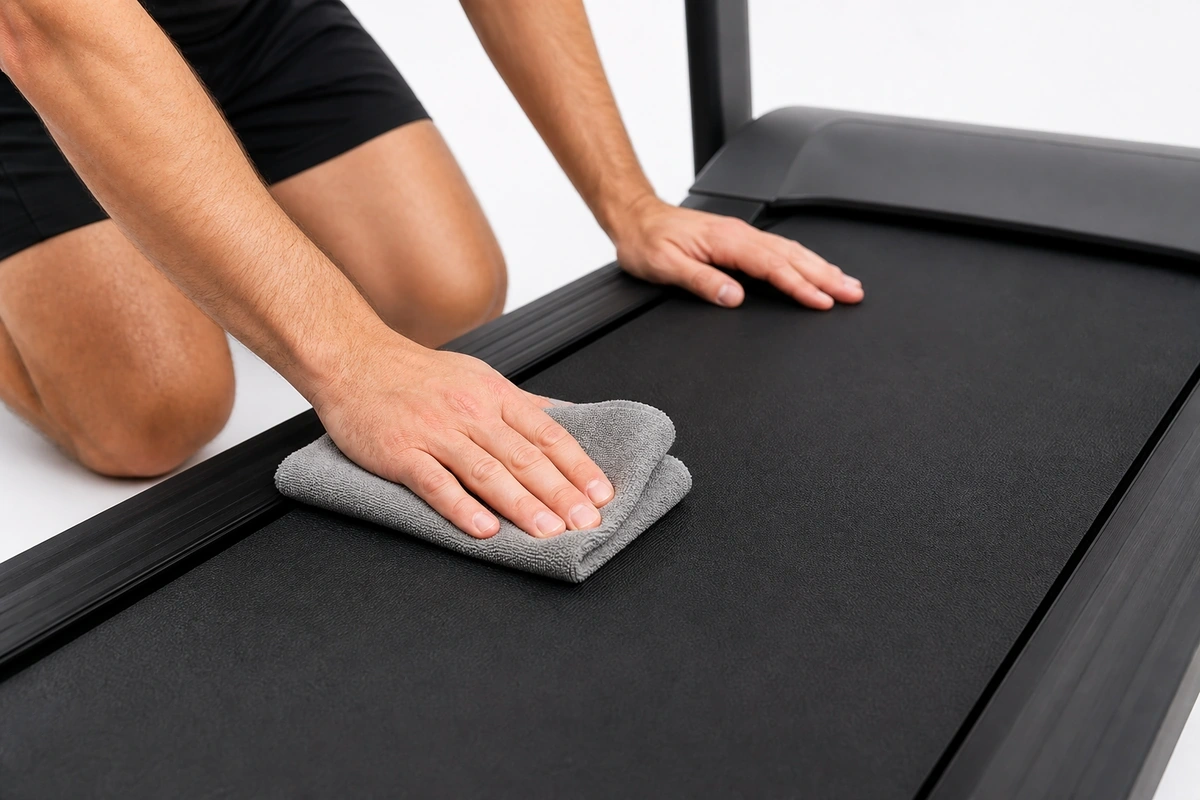
- Wipe sweat off daily. A dry microfiber is enough. Wet cleaning every 2–3 weeks with mild soap.
- Lift the mat monthly to check for trapped moisture (especially on hardwood). Dry both surfaces if damp.
- Rotate (as noted above) every 6 months.
- Don’t vacuum on full suction — aggressive brush rollers can tear the mat edge. Lift-and-wipe works better.
- Expect a quality rubber mat to last 8–10 years under a residential treadmill. PVC: 3–5 years. Foam: 1–2 years.
FAQs
Do I really need a mat if my treadmill is on carpet?
Yes, if your carpet has any plush or memory-foam padding. Without a rigid underlayment + mat, the treadmill will sink unevenly and eventually rock during use. For dense low-pile commercial carpet, a mat alone is fine but still recommended for noise reduction.
Will a treadmill mat fix the noise for my downstairs neighbor?
It will reduce impact noise by 60–70%, which is the difference between “hammer blows” and “muffled thuds.” It will not make the treadmill silent. For maximum apartment-friendly operation, combine the mat with anti-vibration feet under the treadmill frame and avoid running before 7 AM or after 9 PM.
Can I cut a treadmill mat to size?
Rubber mats — yes, with a utility knife and a straightedge (score the top, flex to snap). PVC mats — yes, with sharp scissors or utility knife. Foam mats — yes, but the cut edges fray and shed. Always cut at least 6″ past the treadmill footprint on each side.
Why do some treadmill mats smell for weeks?
Recycled crumb rubber off-gasses residual oils from the recycling process. It’s not toxic (EPA-tested products are fine), but it’s unpleasant. Unbox the mat outdoors for 48 hours before installing, and the smell drops by ~80%. Virgin rubber and EPDM mats don’t have this issue.
What’s the difference between a treadmill mat and a “yoga mat” used under a treadmill?
A yoga mat is 3–6mm thick, made of PVC or TPE foam, and designed for body-weight use. Under a treadmill it compresses in minutes and offers near-zero vibration protection. Don’t substitute.
Can I put a treadmill mat over a radiant-heated floor?
Check the floor manufacturer’s spec first. Most radiant systems tolerate rubber mats fine, but some thin heated-floor systems require airflow to prevent overheating. Rubber insulates — it can trap heat. When in doubt, use a PVC mat (less insulating) or leave the treadmill on the non-heated section of the room.
Take Action
- Measure the treadmill base (add 12″ on each long end for step-off zone)
- Identify your floor type (hardwood, laminate, tile, carpet, concrete)
- Pick thickness by upper-floor vs ground-floor: upper floor or apartment → 1/2″ rubber; ground floor → 3/8″ is enough
- Budget $80–150 for a quality rubber mat at proper size; cheap $30 PVC mats fail in a year
For a broader overview of home gym floor protection, see our best home gym flooring guide. If you’re in an apartment and worried about noise reaching downstairs, a mat is only the first layer — our apartment gym flooring guide covers the full soundproofing stack: 0.47″ high-density gym tiles, IIC ratings by floor type, and the workout-timing rules that keep neighbors off your back.
Questions? Call 888-443-9058 or email customerservice@norsk-stor.com.