Is that play mat really “CPSIA certified,” and does the badge on the carton mean anything? CPSIA is a federal law that every children’s product already has to meet, so the phrase means “the required testing was done” — not that the floor cleared an extra safety bar.
That gap between what a label implies and what it covers is why flooring certifications are so easy to misread. Some are laws. Some are voluntary emissions programs run by private labs.
Two of the most-quoted ones do not apply to a finished floor at all.
This page is the reference. Eight programs, each with a block of its own: who runs it, what it measures, the actual published limits, what it leaves out, and how to check a claim yourself.
Quick Answer: Flooring certifications split into two groups. CPSIA and ASTM F963 are US legal requirements for children’s products, EN 71 is the EU equivalent, and Prop 65 is a California warning law — none is an earned badge. GREENGUARD, CertiPUR-US, FloorScore and OEKO-TEX are voluntary programs a manufacturer pays to earn, each scoped to a specific material.
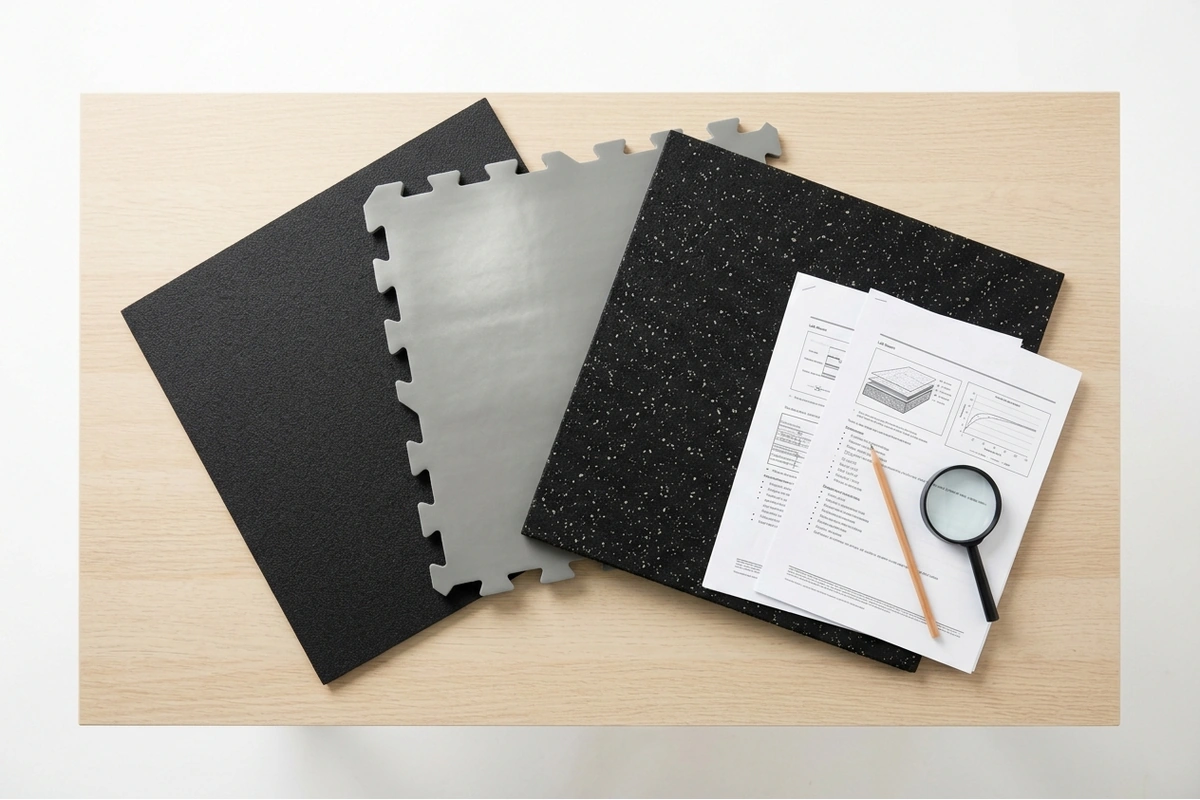
The flooring certification lookup table
Eight programs cover almost every badge you will see on flooring, mats and underlayment. The distinction that matters most is the second column — a legal requirement is not the same thing as a certification a manufacturer chose to pursue.
| Program | Legal status | What it measures | Applies to | Verify at |
|---|---|---|---|---|
| CPSIA | US federal law | Lead, phthalates, third-party testing of children’s products | Anything designed for children 12 and under | cpsc.gov; ask for the Children’s Product Certificate |
| ASTM F963 | US standard, enforced by law | Small parts, flammability, eight heavy elements | Toys and children’s products, including play mats | The lab report from a CPSC-accepted laboratory |
| CA Prop 65 | California warning law | Exposure disclosure for listed chemicals | Anything sold into California | oehha.ca.gov listed-chemicals database |
| EN 71 | EU standard, harmonised under toy-safety law | Mechanical, flammability, migration of elements | Toys sold in the EU, including play mats | The EU declaration of conformity |
| GREENGUARD / Gold | Voluntary certification | Chemical emissions into indoor air | Building materials, finishes, furnishings | spot.ul.com |
| CertiPUR-US | Voluntary certification | Content and emissions of flexible polyurethane foam | Foam material, not finished floors | certipur.us certified-brand list |
| FloorScore | Voluntary certification | VOC emissions from hard-surface flooring | Flooring, adhesives, underlayments | SCS Global Services Green Products Guide |
| OEKO-TEX STANDARD 100 | Voluntary certification | Harmful substances in textile components | Textile and rug-style mats | oeko-tex.com label check |
CPSIA: the US law behind “child safe” flooring
The Consumer Product Safety Improvement Act is the baseline for any mat, tile or rug intended for children 12 and under. It is not optional, and it is not a badge a brand earns by going further than its competitors.
Three limits do the work. Total lead content is capped in every accessible component part, surface coatings get a tighter cap of their own, and regulated phthalates are capped by weight.
Fact: CPSIA caps total lead in children’s products at 100 ppm in any accessible component part, and lead in paint or similar surface coatings at 90 ppm (US Consumer Product Safety Commission — CPSIA section 101; 16 CFR part 1303 for surface coatings).
Phthalates are limited to 0.1 percent for any regulated compound in a children’s toy or child care article. Eight are permanently prohibited: DEHP, DBP, BBP, DINP, DIBP, DPENP, DHEXP and DCHP.
The enforcement mechanism is paperwork you can ask for. Testing must be done at a CPSC-accepted laboratory, and the importer or manufacturer issues a Children’s Product Certificate listing every rule the product was tested against.
What it does not cover: indoor air quality. CPSIA says nothing about how much a floor off-gasses once it is in the room. If odor or VOCs are your concern, this is the wrong document to ask for — see the emissions programs further down. Our guide to non-toxic foam play mats walks through how that plays out on a real shopping list.
ASTM F963: the toy standard flooring gets tested to
ASTM F963 is the Standard Consumer Safety Specification for Toy Safety, published by ASTM International. The CPSIA makes it legally enforceable in the United States, which is why a play mat can be tested to a “toy” standard.
The numbers tell the story: the standard sets limits on eight heavy elements — antimony, arsenic, barium, cadmium, chromium, lead, mercury and selenium — in both substrate materials and surface coatings. That is a wider net than the lead-only limits most shoppers know about.
It also covers small parts and choking hazards, which matters for interlocking mats with removable border strips, and flammability behavior.
The current revision is F963-23, mandatory for toys manufactured on or after 20 April 2024. A supplier claiming compliance should be able to name the revision and the CPSC-accepted laboratory that ran the tests.
What it does not cover: durability, slip resistance or emissions. A mat can pass every chemical requirement and still curl at the edges within a year. For thickness and wear guidance on kids’ rooms, the play mats for toddlers guide is the practical companion to this page.
California Prop 65: a warning label, not a certification
Proposition 65 is the most misunderstood item on any flooring box. It requires businesses to warn Californians about significant exposures to chemicals the state has listed as causing cancer, birth defects or reproductive harm.
Fact: About 900 chemicals have been added to the Proposition 65 list since 1987, and the law is a warning and disclosure mechanism rather than a product certification program (California OEHHA).
There is one exception to how people usually read it: the absence of a warning is not a government clearance. It usually means the business concluded that exposure falls below the safe harbor level, or that no listed chemical is present. No agency inspected the product to reach that conclusion.
A warning is equally weak as a signal in the other direction. Many manufacturers apply the label defensively across an entire catalog rather than run exposure assessments product by product.
What it does not cover: everything outside California, and any judgment about how much exposure actually occurs in your home. Treat it as a disclosure to read, not a grade to compare. The same caution applies when you are comparing playroom flooring options across brands.
What these three standards mean for the mats and tiles we make
Norsk-Stor foam mats are lab tested to ASTM F963, the US toy-safety standard, and are CPSIA and CA Prop 65 compliant — lead free, phthalate free and latex free. That is the honest scope of the claim, and it is the scope we publish.
Our foam floor tiles and children’s designer foam mats sit in that children’s-product category, so the toy-safety testing applies to them directly. The interlocking PVC tiles are garage and workshop products rather than children’s products, which is a different regulatory lane entirely — the garage flooring options guide covers what to weigh there.
Naming the standards a product is tested to, and stopping there, is the whole point of a reference page. A badge you cannot trace to an issuing body and a certificate number is marketing, not evidence.
Most of the programs below — GREENGUARD, CertiPUR-US, FloorScore, OEKO-TEX — are voluntary schemes run by independent laboratories: a manufacturer has to opt in, pay for testing and stay in the registry to keep using the mark. EN 71, covered below, is the exception — it’s a legal requirement in its market, not a voluntary one. Knowing which is which, and which can even apply to a given material, saves a lot of wasted searching.
GREENGUARD and GREENGUARD Gold: chemical-emissions testing
GREENGUARD is an indoor air quality certification from UL Solutions, issued against UL 2818, the certification program for chemical emissions from building materials, finishes and furnishings. It answers a question none of the standards above touch: how much does this product release into the air of the room it is installed in?
Certification is voluntary and product-specific. A brand can hold it on one SKU and not another, which is why “GREENGUARD certified brand” is a claim worth checking line by line.
GREENGUARD Gold is the stricter tier. It applies lower VOC emission limits, complies with California Section 01350, and screens more than 360 VOCs — the tier aimed at schools, healthcare settings and children’s rooms.
Verification is straightforward. The UL SPOT database lists more than 80,000 certified products and is searchable by brand and product name.
What it does not cover: chemical content. This is an emissions test, so a material can pass while still containing substances a content-based program would flag. It also says nothing about lead, phthalates or physical safety.
CertiPUR-US: a foam certification, not a floor certification
CertiPUR-US certifies flexible polyurethane foam. Not mattresses, not sofas, and not finished flooring — the mark belongs to the foam material inside a product.
The program prohibits ozone depleters, PBDE and Tris flame retardants, mercury, lead and other heavy metals, formaldehyde, and phthalates regulated by the CPSC. It also screens for substances classified as carcinogenic, mutagenic or reprotoxic.
Fact: CertiPUR-US verifies certified flexible polyurethane foam at less than 0.1 ppm formaldehyde and low VOC emissions of less than 0.5 ppm (CertiPUR-US, About the Certification).
Compare that with what most play mats are made of. EVA and cross-linked polyethylene foam are not polyurethane, so they fall outside the program entirely — the absence of the mark on an EVA mat carries no information at all.
What it does not cover: every foam chemistry other than flexible polyurethane, and the finished product wrapped around it. A mattress with certified foam is not itself certified.
FloorScore: the one written for hard-surface flooring
FloorScore is the indoor air quality certification built specifically for hard-surface flooring, adhesives and underlayments. It is administered by SCS Global Services with the Resilient Floor Covering Institute.
Fact: FloorScore tests products against the California Department of Public Health Standard Method v1.2, Section 01350, evaluating 35 individual volatile organic compounds including formaldehyde (SCS Global Services).
Eligible categories are broad: vinyl, laminate, rubber, cork, ceramic and porcelain tile, hardwood, bamboo, linoleum, cementitious flooring, raised flooring, underlayments, adhesives, wall base, stair treads and accessories.
Certified products are listed in the SCS Global Services Green Products Guide, which is the place to confirm a claim rather than trusting a logo on a product page.
What it does not cover: structural performance, slip resistance, wear rating, and any chemical that is not on the CDPH list of 35. It is an emissions certification with a defined scope, not a general safety endorsement.
EN 71: the European toy standard behind “EN 71 certified” mats
EN 71 is the European toy safety standard, harmonised with the EU Toy Safety Directive. Toys placed on the EU market must meet the Toy Safety Directive; EN 71 is the harmonised standard used to show they do — and it is not a US requirement.
Three parts do most of the work on play mats. Part 1 covers mechanical and physical properties such as size, shape, strength and durability. Part 2 covers flammability, including which materials are prohibited outright.
Fact: EN 71-3 sets migration limits for 19 elements — including aluminium, antimony, arsenic, barium, boron, cadmium, chromium III and VI, cobalt, copper, lead, manganese, mercury, nickel, selenium, strontium, tin, organic tin and zinc (CEN, EN 71-3:2019+A2:2024).
Migration testing differs from total-content testing in a useful way: it measures how much of an element can transfer out of the material under simulated conditions, which is closer to what a child is actually exposed to.
What it does not cover: US market access. An EN 71 test report is a genuine third-party result, but it does not substitute for CPSIA documentation on a product sold in the United States.
OEKO-TEX STANDARD 100: the textile-components certification
OEKO-TEX STANDARD 100 is run by the International OEKO-TEX Association, a group of independent textile and leather research institutes. It tests textile components — yarns, fabrics, backings, coatings and threads — against a list of harmful substances, and every component of an article has to pass before the label is issued.
Limits are set by product class. Class I, the strictest, covers articles for babies and toddlers, and the limits loosen as a product moves further from prolonged skin contact.
What it does not cover: foam, PVC and rubber, which is what most play mats and floor tiles are actually made of, and the finished product as a system. A certified textile face does not certify the slab underneath it. Verify any claim with the label check on oeko-tex.com, using the certificate number printed on the label.
Which certification applies to which floor type
Half of the confusion around flooring certifications comes from looking for a mark that cannot exist on that material. This table sorts it out.
| Floor type | Legally required in the US | Emissions program that can apply | Marks that cannot apply |
|---|---|---|---|
| EVA foam play mats | CPSIA and ASTM F963 if intended for children | GREENGUARD or Gold | CertiPUR-US (not polyurethane) |
| Polyurethane foam mats and toppers | CPSIA if intended for children | GREENGUARD or Gold | FloorScore is uncommon for soft goods |
| Interlocking PVC or vinyl tiles | General product safety rules | FloorScore, GREENGUARD | CertiPUR-US, OEKO-TEX |
| Rubber gym tiles and rolls | General product safety rules | FloorScore, GREENGUARD | CertiPUR-US, OEKO-TEX |
| Rug-style or textile play mats | CPSIA if intended for children | GREENGUARD, OEKO-TEX STANDARD 100 | FloorScore (hard surface only) |

How to verify a certification claim in four steps
A claim you cannot check is not evidence. These four steps take a couple of minutes and settle almost every dispute.
- Ask which document backs the claim. For a US children’s product that is the Children’s Product Certificate; for an emissions program it is a certificate number from the issuing body.
- Search the issuing body’s registry, not the seller’s site. UL SPOT for GREENGUARD, the SCS Green Products Guide for FloorScore, the certified-brand list for CertiPUR-US. If the product is not in the registry, the mark is not current.
- Check the scope line. Certificates name a specific product, SKU or material — a certificate covering one colorway or one foam component does not cover the whole catalog.
- Check the date. Certifications expire and require re-testing. An undated logo in a product image is the weakest form of the claim.
Frequently asked questions
Is “CPSIA certified” the same as passing an extra safety test?
No. CPSIA compliance is mandatory for children’s products in the United States, so the phrase describes required testing rather than an optional achievement. What it does confirm is that a CPSC-accepted laboratory ran the tests and that a Children’s Product Certificate exists. Ask to see that certificate — the document, not the logo.
What lead limit does a children’s floor mat have to meet?
Total lead is capped at 100 ppm in any accessible component part, and lead in paint or similar surface coatings is capped at 90 ppm. Both limits come from the Consumer Product Safety Commission and apply to products intended for children 12 and under. Testing must happen at a CPSC-accepted laboratory.
Does a Prop 65 warning mean the flooring is unsafe?
Not by itself. The warning signals that a business believes exposure to a listed chemical may occur above the safe harbor level, and many manufacturers apply the label across a whole catalog as a precaution. The absence of a warning is not a government safety clearance either. Read it as disclosure, not as a grade.
Can a floor be CertiPUR-US certified?
No. The program certifies flexible polyurethane foam as a material, so a finished floor cannot hold the mark, and neither can EVA or cross-linked polyethylene mats. If a hard-surface floor is what you are checking, the emissions program written for that category is FloorScore. Matching the program to the material saves a lot of wasted searching.
What is the difference between GREENGUARD and GREENGUARD Gold?
Gold is the stricter tier of the same UL 2818 emissions program: lower VOC limits, California Section 01350 compliance, and screening of more than 360 VOCs. Both certify chemical emissions into indoor air. Gold is the one specified for schools, healthcare environments and children’s rooms. The difference is the threshold, not the subject. Verify either tier in the UL SPOT database rather than trusting a badge image.
Does an EN 71 report count for a mat sold in the United States?
It is a real third-party result, but it is not US documentation. EN 71 is harmonised with the EU Toy Safety Directive and applies to toys placed on the European market. A product sold in the United States still needs CPSIA testing and a Children’s Product Certificate covering the applicable rules.
The short version
- A legal requirement and a voluntary certification are different things; only the second one is a mark a manufacturer chose to earn.
- Content limits and emissions limits answer different questions, and no single program covers both.
- Match the program to the material before you go looking for a badge, or you will hunt for a mark that cannot exist.
- Every real claim traces to an issuing body, a certificate number, a scope and a date. Anything else is a logo.
Shopping for a children’s space and want the standards spelled out on the product page instead of buried? The Norsk-Stor foam floor tiles range lists exactly what each mat is tested to.